Expeditions · Safari, decoded 2026
What Is a Safari, Really? The Nine Hidden Choices Behind Every Safari in 2026, Drawn
A safari is a trip to watch wild animals where they live, and behind that one word sit nine choices that decide what you actually get: whose land you are on, how you move, where you sleep, who guides you, who shares your vehicle, when you go, what the price includes, what you are likely to see and who sold you the trip. The usual short answer, “seeing wild animals in Africa”, is only the part above the waterline. At one end of the range, a day in South Africa's Kruger National Park costs an international adult R602 in conservation fees, and you can drive yourself; at the other, Singita Serengeti House in Tanzania costs US$17,195 a night for up to four guests in peak season, with its own guide, chef and vehicle. Both are sold as a safari. The drawings below take the nine choices one at a time, using 2026 rate sheets and the rules as the park authorities publish them.
Verified 29 September 2026 · SANParks, TANAPA, NCAA, Maasai Mara and Mara North rules and fees · Visit Rwanda permits · 2026 rate pages from Kicheche, Singita, Asilia, Elewana and Great Plains · Merriam-Webster and National Geographic · re-read at source
What is a safari, really?
A safari is a trip to watch wild animals in their own habitat, and what that trip turns out to be depends on nine choices that a brochure rarely spells out. The iceberg below puts the common answer on top and the nine choices underneath, from the ones you would notice in a photograph to the ones that only show up in a rate sheet or a park's rulebook. Each band links to its drawing further down the page.
“Seeing wild animals in Africa”The usual answer, above the waterline
- 1Whose land it isPark, reserve, conservancy or private land, each with its own rules and feesSee it
- 2How you moveNine ways, from a closed 4x4 to a dugout canoe and a balloonSee it
- 3Where you sleepA park rest camp, canvas, a camp that moves, or a whole houseSee it
- 4Who guides youYou, a driver-guide, a ranger and tracker, or an armed scout on footSee it
- 5Who shares your vehicle“Private” can mean the vehicle, the guide or the entire houseSee it
- 6When you goAt its lowest rate, the same tent costs 31 to 37% less than in peakSee it
- 7What the price includesFour rate names, and the park fee sat outside all five rates checkedSee it
- 8What you are likely to seeThe Big Five was a hunters' list; the herds are mostly wildebeestSee it
- 9Who sold it to youThe camp, a planner, a marketplace or a group-tour companySee it
Seen in a photographFound in the rate sheet
Where does the word safari come from?
From Swahili, in which safari means journey: Merriam-Webster traces it to the Arabic safarī, “of a journey”, and dates its first known use in English to 1859, when it meant a hunting caravan in eastern Africa. The dictionary's second sense is simply “journey, expedition”, which is how one word came to cover everything from a walk behind an armed scout to a hot-air balloon. Watching without shooting is younger than the word, and the line under the card shows how the meaning moved.
safari
noun · from Swahili, “journey” · first known use in English: 1859
- “the caravan and equipment of a hunting expedition especially in eastern Africa; also : such a hunting expedition”
- “journey, expedition”, as in “an arctic safari”
Etymology: “Swahili, journey, from Arabic safarī of a journey” (Merriam-Webster). Etymonline dates it later, to 1890 as an English word and to 1860 as a foreign one.
How the meaning moved
- 1859First known English use, for a hunting caravan in eastern Africa
- Late 1800sTrophy hunters coin “the Big Five” for the animals most dangerous to hunt on foot
- 1950sNorman Carr starts walking safaris in Zambia's South Luangwa Valley
- 1993The last fences between private Sabi Sand and Kruger National Park come down
- 2014Botswana bans elephant hunting
- 2019Botswana lifts the ban, in a ministry statement of 22 May
Red ring: huntingGreen ring: watching and walkingGold ring: land
Sources for the line: Merriam-Webster; National Geographic on the Big Five; Time + Tide, which took over Norman Carr Safaris; the Sabi Sand Nature Reserve; and National Geographic on Botswana's hunting ban. Walking safaris today are covered in the Time + Tide review.
How many different trips does one word cover?
On paper, 324,000: eight of the nine choices come with three to nine common options each, and multiplied together they make 324,000 combinations. Many cannot exist in practice (there are no gorillas to trek in Kruger), but enough can that two people who have both “been on safari” may have done almost nothing the same. The ninth choice, what you see, is the result of the other eight.
Why does the same animal come with different rules?
Because the rules belong to whoever controls the land, not to the animal: a lion in the Serengeti, in the Ngorongoro Crater, in the Maasai Mara reserve, in a Mara conservancy and in Kruger is watched under five different rulebooks, with five different fees and clocks. The five cards set them side by side. Green tags mark what is allowed, red what is not, gold what is allowed only under conditions or up to a limit, and grey the fees; every tag also says it in words.
Serengeti National Park
National park · Tanzania · TANAPA
- ✗ Not allowedLeaving the authorised tracks: park rules keep vehicles on them (Forbes, July 2025).
- FeeUS$70 per adult per day, US$60 from 15 March to 15 May, plus 18% VAT (TANAPA 2023/24 tariff, the latest it publishes).
- FeeConcession fee at camps inside the park: US$60 per person per night from July to September, US$50 from October to June, plus VAT.
- MapSerengeti National Park on Google Maps
Ngorongoro Conservation Area
Conservation area · Tanzania · NCAA
- Only ifDriving off-road: “not permitted within NCA unless authorized by the Conservation Commissioner” (NCAA guidelines).
- LimitAt most five vehicles at a sighting.
- FeeUS$70.80 per adult per 24 hours, and US$295 per vehicle for each trip down to the crater floor (NCAA tariffs).
- MapNgorongoro Conservation Area on Google Maps
Maasai Mara National Reserve
National reserve · Kenya · Narok County
- FeeUS$200 per non-resident adult for a 12-hour ticket from July to December, US$100 from January to June (Daily Nation, 2026).
- LimitThe ticket covers 12 hours, and the reserve operates from 6am to 6pm.
- MapMaasai Mara National Reserve on Google Maps
Mara North Conservancy
Community conservancy · Kenya · Maasai landowners
- Only ifLeaving the track: only for the Big Five, by the shortest route, and no closer than 20 metres (Mara North drive rules).
- LimitNo more than five vehicles at a sighting, ten minutes each.
- ✓ AllowedNight drives, back in camp by 10pm.
- FeeA conservancy fee on top of the room: US$130 per adult per night at Kicheche Mara North in 2026.
- Limit336 acres of land per bed (Mara North).
- MapMara North Conservancy on Google Maps
Kruger National Park
National park · South Africa · SANParks
- ✓ AllowedDriving yourself on the park's roads.
- ✗ Not allowedGetting out of the vehicle except in designated areas, and “no part of the body may protrude from a window or sunroof” (SANParks).
- Limit50 km/h on tar and 40 km/h on gravel, and no driving before or after gate times, which change by month (gate times).
- Only ifBeing out after dark: only on a SANParks guided night drive, which leaves at 19:30 or 20:00 and lasts about two hours; no children under 6 (SANParks drives).
- FeeR602 per international adult per day and R300 per child, from 1 November 2025 to 31 October 2026 (SANParks fees).
- MapKruger National Park on Google Maps
The fee lines differ in kind as well as in amount. Tanzania charges per person per day, per 24 hours or, at Ngorongoro, per vehicle for each trip into the crater; the Mara reserve sells a 12-hour ticket; the conservancies add a nightly fee to the room; Kruger charges per person per day. Who owns each piece of land, and how the camps pay for it, is mapped in how the safari industry works, and the costs by country are in the Tanzania, Kenya and South Africa cost guides.
What are the different ways to go on safari?
At least nine, each with its own vehicle, guide, rules and price: a closed 4x4 with a driver-guide, a fly-in safari using each camp's open vehicles, self-drive, on foot, by mokoro, by boat, on horseback, by balloon and, for gorillas, a guided trek. The two scenes place all nine; the numbered cards underneath say what each involves and what it costs, as published.
Gold figures: guides and polersRed figure: armed scoutBlue figures: guests
- 1Closed 4x4 with a driver-guideOne guide drives you from park to park in “a 4x4 closed land cruiser, with a pop-up roof for easy game viewing” (Travel Butlers).Micato limits each nine-passenger vehicle to six guests, so everyone gets a window seat and a roof hatch.
- 2Fly-inLight aircraft hop between airstrips and each camp meets you in its own vehicle; camp vehicles “tend to be open (but still with a canopy on the roof)” (Travel Butlers).Coastal Aviation, Arusha to Seronera: US$259 per adult plus taxes; 15 kg of luggage per person.
- 3Self-driveYou drive your own or a hired car on the park roads and stay inside it, under the park's speed limits and gate times.Kruger: R602 per international adult per day. More in the Namibia self-drive guide.
- 4On footA guide leads a small file through the bush, and “every walking safari in Zambia is accompanied by an armed scout”, a trained member of the Department of National Parks and Wildlife (Kafunta).Minimum age 12 in South Luangwa; 16 for Singita's bush walks.
- 5MokoroA dugout canoe in the Okavango Delta's shallow channels: “Oarsmen stand in the stern and push with a pole” (Botswana Tourism).Traditionally cut “from trunks of a large straight tree, like ebony or kigelia”. See the Okavango Delta operators.
- 6BoatA river cruise on the Chobe gets you “up closer to hippo, crocodile and a mind-boggling array of water birds than you ever would on land” (Botswana Tourism).Chobe Game Lodge's skimmer boats take up to 12 guests.
- 7HorsebackYou ride through the game on horseback, and only competent riders go: Okavango Horse Safaris asks riders to trot for 10 minutes at a time and “gallop out of trouble” (riding requirements).Maximum rider weight 90 kg. See the horseback safari operators.
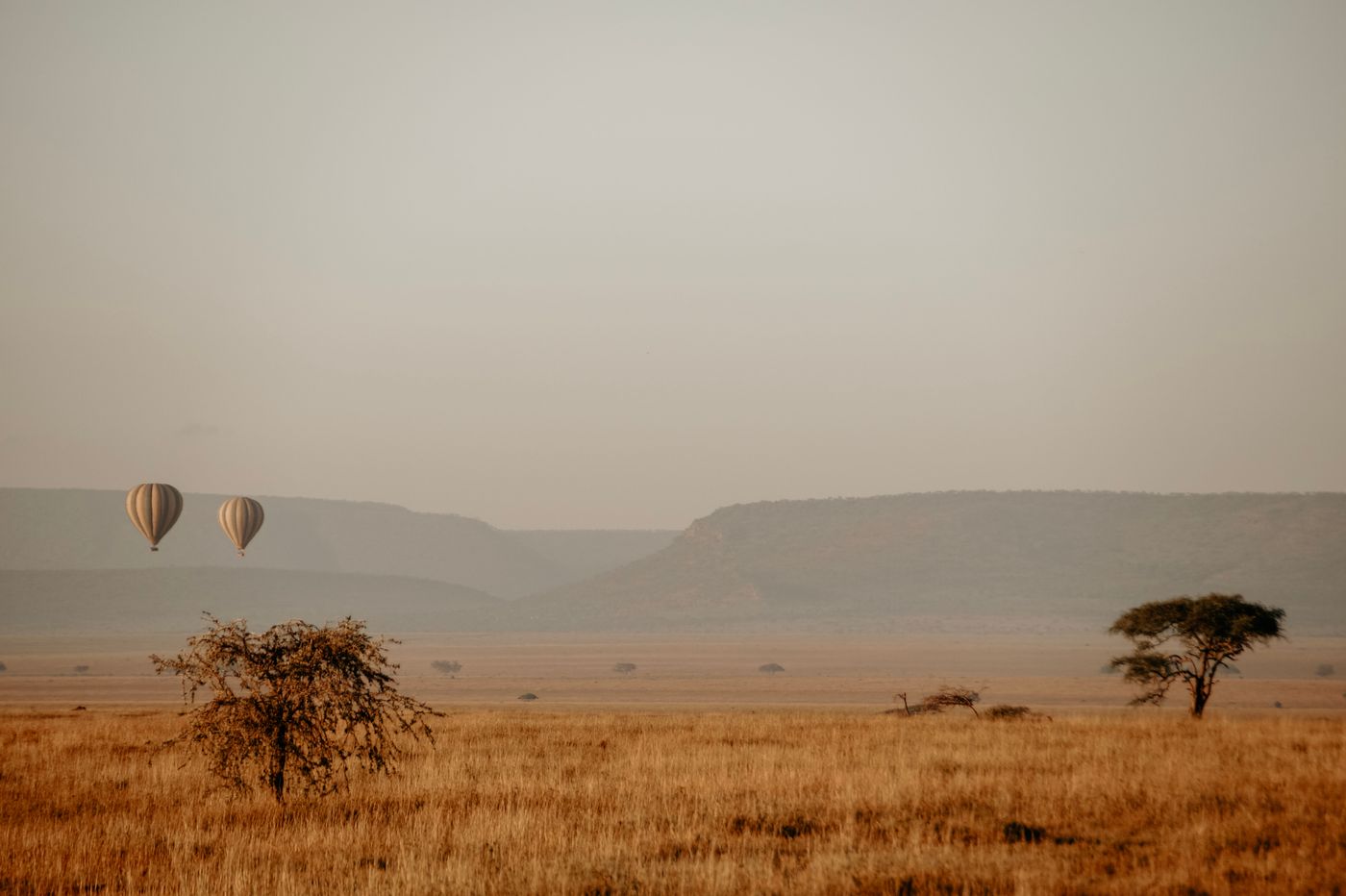
- 8BalloonAbout an hour drifting over the plains at sunrise, then a champagne toast and a full English breakfast (Serengeti Balloon Safaris).US$599 per person in a shared balloon, US$660 from 1 January 2027; park entry fees extra.
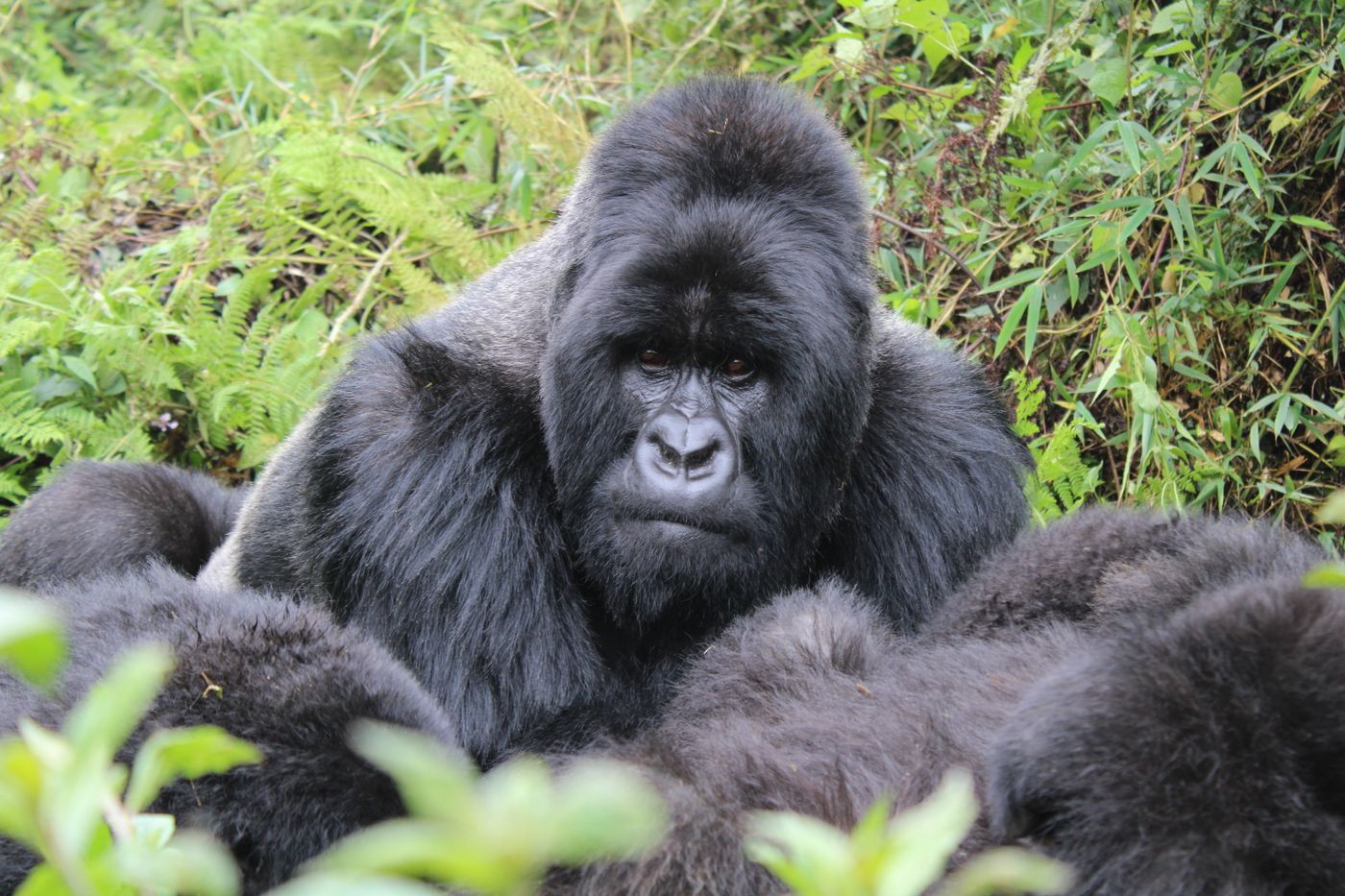
- 9Gorilla trekA guided hike to a gorilla troop in Rwanda: eight permits per troop per day, and at most one hour with the gorillas (Visit Rwanda).US$1,500 per person; minimum age 15. See the gorilla trekking index.
Where do you sleep on a safari?
Anywhere from a park-run rest camp you drive into yourself to a private house with its own staff; between the two sit permanent tented camps, mobile camps that move with the herds and one-night fly camps. The five below run from the most shared to the most private, each with a named 2026 example.
-
Park rest campBungalows, safari tents and campsites run by SANParks; the main camps have a shop, a restaurant or cafeteria and a petrol station.Priced on request, plus R602 a day in park fees
-
Permanent tented campCanvas suites on a fixed site, with the camp's own vehicles and guides. Singita Sabora has nine.US$2,210 to US$3,220 per adult per night
-
Mobile campMoves with the herds: Asilia's Olakira is at Ndutu from December to March, in the northern Serengeti from June to October.From US$1,100 per person per night
-
Fly campA night away from the main camp, reached on an afternoon walk with an armed guide.US$175 per person at Asilia's Naboisho Camp, on top of the rate
-
Private houseA whole house, its staff and a vehicle: Singita Serengeti House, four suites, up to eight guests.US$17,195 a night for 1 to 4 guests, peak 2026
More guests around youOnly your party
Canvas says nothing about price: Singita Sabora's tented suites cost up to US$3,220 per adult per night in 2026 (Singita rates), while Asilia's Olakira mobile camp starts at US$1,100, and Singita Serengeti House is priced per house, not per person (Serengeti House rates). Kruger's rest camps are listed on the SANParks camps page, and fly camping, in which “you spend the afternoon walking to the fly camp, away from the main site” with an armed guide, needs a three-night stay at Naboisho Camp, at least two people and a minimum age of 12. The camp companies themselves are compared in the Singita and Asilia reviews.
Who guides you on a safari?
It depends on the vehicle and the land: on a road safari one driver-guide drives and guides, on a game drive in a South African private reserve such as Thornybush a ranger drives while a tracker watches the ground from the front of the vehicle, and on foot an armed scout leads the guide and guests in single file. On a Kruger self-drive, you are the guide. The seat maps are drawn from above, with the front at the top.
G: guide or rangerT: trackerS: armed scoutUnlettered: guestsDashed circle: empty seat
Closed 4x4, driver-guide
One guide drives and guides the whole route, in “a 4x4 closed land cruiser, with a pop-up roof for easy game viewing” (Travel Butlers). The dashed line is the roof hatch.
Micato limits each nine-passenger vehicle to six guests, so every traveller has a window seat.
Open vehicle, ranger and tracker
The ranger drives; the tracker “sits at the front of the vehicle” (Thornybush), where, Londolozi writes, trackers look for fresh animal tracks.
On a shared drive at Asilia's camps, a vehicle takes a maximum of six guests.
On foot, scout and guide
In South Luangwa the armed scout leads, the guide follows and the guests walk behind, always in single file (GoGo).
Zambia's Wildlife Camp caps a walk at six guests under the country's wildlife rules.
Gorilla treks follow a pattern of their own. In Rwanda a permit costs US$1,500 per person, the minimum age is 15, eight permits are issued per gorilla troop per day, and each troop meets visitors for “a strict maximum of one hour per day”; there are “only 96 permits available each day in Rwanda” (Visit Rwanda). Timing and costs are in the best time for gorilla trekking in Rwanda and the Rwanda safari cost guide, and guides who have won the trade's awards are listed in safari guide of the year winners.
What does a private safari actually mean?
Three different purchases share the word: your own vehicle at a shared camp, your own guide and vehicle for the whole trip, or exclusive use of an entire house with its staff. All three start from the same floor, a shared vehicle: Asilia's game drives are “limited to a maximum of six guests”, and “private vehicles can also be arranged” (Asilia). Each step up changes what you pay and who else is there.
Other camps price the first step differently: Angama Mara charges US$400 for a full day with a private vehicle in its standard season and US$800 in its peak season, which it gives as June to October and the festive period. The Kicheche figures are from its 2026 rack rates, and Asilia's rate definitions from its guide to full board, game package and all-inclusive.
“Private reserve” and “private concession” describe the land, not your privacy. They say who holds the ground a camp sits on, such as the landowners of the Sabi Sand next to Kruger. A camp on private land can still put you on a shared drive, so ask which of the three steps a quote includes.
Why does the same camp cost different amounts in different months?
Because camps and parks both price by season: at Kicheche Mara North a March night costs 37% less than an August night, at Singita Sabora a February night costs 31% less than an August night, and the Maasai Mara reserve halves its ticket from January to June. The strips below draw each camp's 2026 in half-months, with each bar's height in proportion to that half-month's nightly rate.
Kicheche Mara North, 2026: per adult per night, sharing
Peak: US$995, 1 July to 31 October and 20 December to 2 JanuaryMid: US$730, 3 January to 28 FebruaryRegular: US$625, March, 23 May to 30 June and 1 November to 19 DecemberClosed: 1 April to 22 May
Singita Sabora Tented Camp, 2026: per adult per night, sharing
Peak: US$3,220, 16 May to 30 September and 15 December to 5 JanuaryShoulder: US$2,795, OctoberOff-peak: US$2,210, 6 January to 15 May and 1 November to 14 December
Each strip is drawn to its own camp's peak rate, so the two compare shapes, not prices. Sources: Kicheche's 2026 rack rates and Singita's Sabora rates.
The cheapest weeks are what Asilia calls green season: “Green season runs through the long rains of April and May”, and “Green season simply costs less” (Asilia). At Elewana's Serengeti Migration Camp, full board costs US$584 per person sharing from 1 April to 31 May 2026, against US$1,081 in high season (Elewana rates). Some camps close instead: Kicheche Mara North shuts on 1 April and reopens on 23 May. Park fees follow a calendar too: the Serengeti's daily fee drops from US$70 to US$60 between 15 March and 15 May, and the Maasai Mara reserve charges US$100 from January to June against US$200 from July to December. Where the herds are in each of those months is in the Great Migration, month by month, and the trade-offs by month in the best time to go on safari.
What does all-inclusive mean on a safari?
Whatever the camp says it means: full board, game package, all-inclusive and fully inclusive have no fixed definitions, and in all five 2026 rates below the park or conservancy fee is charged on top. Read each card's last line first.
| Camp and rate | Meals | Drinks | Game drives | Laundry | Airstrip transfers | Park or conservancy fees |
|---|---|---|---|---|---|---|
| Elewana Serengeti Migration Camp, full boardUS$584 per person sharing, green season 2026 | ✓ Included: breakfast, lunch and dinner | ✓ Included: teas, coffees, soft drinks, beer, house wines and selected spirits | ✗ Not included: the game package adds them | ✓ Included | ✗ Not included | ✗ Extra: park, reserve, conservancy and camping fees |
| Elewana Serengeti Migration Camp, game packageUS$884 per person sharing, green season 2026 | ✓ Included: as full board | ✓ Included: as full board | ✓ Included: scheduled shared game drives and activities | ✓ Included | ✓ Included: to and from its designated airstrips | ✗ Extra: park, reserve, conservancy and camping fees |
| Asilia Olakira Migration CampFrom US$1,100 per person per night | ✓ Included: full board | ✓ Included: all house drinks except champagne | ✓ Included: scheduled drives in open vehicles | ✓ Included: a limited service | ✓ Included: Kogatende or Ndutu airstrip | ✗ Extra: park fees, camping fees and the Asilia conservation charge |
| Singita Sabora Tented CampUS$2,210 to US$3,220 per adult per night, 2026 | ✓ Included: all meals | ✓ Included: including premium wines, spirits and liqueurs | ✓ Included: twice a day, in open vehicles | ✓ Included | ✓ Included: by road from Sasakwa airstrip | ✗ Extra: wildlife, park and concession fees, and the Tourism Development Levy |
| Great Plains Mara Expedition Camp, “fully inclusive”From US$1,225 per person sharing | ✓ Included: all meals | ✓ Included: including premium drinks | ✓ Included: scheduled activities in the reserve and Mara North | ✓ Included | ✓ Included: by road from Ol Kiombo airstrip | ✗ Extra: conservation and park fees |
Sources: Elewana, Asilia, Singita and Great Plains (trade rates, camp page), each read on 29 September 2026.
Four rate names, as the camps define them
At Elewana: accommodation, all meals, teas, coffees, soft drinks, beer, house wines, selected spirits and laundry. Asilia says full board “is typically associated with driving safaris”, on which travellers have their own guide and vehicle.
✗ Park fees: extraAt Elewana: full board plus “scheduled shared game drives and activities, and transfers to/from our designated airstrip(s)”. Asilia says a game package “is often part of a flying safari”.
✗ Park fees: extra at ElewanaAsilia's own guide says an all-inclusive safari “covers virtually everything”, park fees included; its camp rate pages, updated in September 2026, list park fees as extra.
? Park fees: check the excludes lineGreat Plains calls its Mara Expedition Camp rate “fully inclusive” of meals, drinks, laundry, activities and airstrip transfers, and “exclusive of conservation/park fees”.
✗ Park fees: extraThe small print moves too: Asilia includes Tanzania's Tourism Development Levy in its Olakira rate, while Singita lists the same levy as extra at Sabora and still describes its rates as “inclusive of tax”. To turn a nightly rate into a trip total, use the safari price-per-night decoder; why the totals land where they do is in why safaris cost what they do.
Will you see the Big Five on safari?
Perhaps, but the list was never about watching: National Geographic says the term was “coined in the late 1800s during Africa's colonial period” for “what trophy hunters considered the most challenging and dangerous animals to hunt on foot”. It says nothing about which animals are most common, most beautiful or easiest to find (National Geographic).
- Lion
- Leopard
- Elephant
- African buffalo
- Rhinoceros
What fills the plains is another list. In the Serengeti's Great Migration, National Geographic counts as many as 1.3 million wildebeest, over 400,000 Thomson's gazelles and more than 200,000 zebra: “Nearly two million herbivorous animals, all feeding together.”
Figures from National Geographic, 28 April 2026, with the bars drawn to scale. Which animals you are likely to see, country by country, is in safari animals: what you actually see, and choosing between countries in which safari country is right for you.
Who actually sells you the safari?
One of five kinds of company, and several of them can sell you the same tent: the camp itself, a planner owned by a camp company, an independent planner, a marketplace of tour operators, or a group-tour company with fixed departures. The difference between the doors is who designs the route, holds the camps, takes your money and answers the phone when a flight or a river crossing moves.
- The campBook the lodge company direct: Singita takes direct bookings by phone or email.
- A camp company's plannerYellow Zebra, which merged with Wilderness in 2021.
- An independent plannerExtraordinary Journeys, which owns no camps.
- A marketplaceListing sites such as SafariBookings and BookAllSafaris, where tour operators post their trips.
- A group-tour companyFixed departure dates, a set route and a group you join.
Five doors, one tent. Safari.com says lodges and operators must sell at the same rate whether you book direct or through a specialist (Safari.com FAQ); if that holds, the room costs the same behind every door, and what you are choosing is the company that plans and stands behind the trip.
Who does what behind each door, and how each is paid, is drawn in how the safari industry works. Choosing between them is covered in who to book your safari through and safari specialist vs booking direct, and the independent planner named above is assessed in the Extraordinary Journeys review.
Partner · paid placement
Extraordinary Journeys
Extraordinary Journeys designs tailor-made trips across Africa, Asia, South America, Oceania, and the Middle East, and is best known for thoughtful planning and highly personalized trips, earning consistently exceptional reviews from its clients. Founded by a mother and daughter, the company has kept a family-first approach: many of its planners are parents who travel with their own children, making it a particular favorite for family and multigenerational trips.
“We loved how tailored it was to the kids being accepted and welcomed everywhere we went. It felt extremely classy, remote, perfect.”
Extraordinary Journeys is a paid partner. Partners are labelled; scores and rankings cannot be bought. How this site is funded →
What should you ask to decode a safari quote?
Five questions, one for each hidden choice that moves the price: whose land and which fees, which vehicle and who shares it, who guides, which rate basis, and which season each night falls in. Any quote should answer all five in writing.
- Whose land is each night on, and are its fees in the price? Ask for the park, reserve or conservancy by name. Kicheche's US$130 conservancy fee and Singita's park and concession fees both sit outside the nightly rate.
- Which vehicle, and who else is in it? Closed with a pop-up roof or open; shared with up to six guests, or your own, which costs US$350 to US$400 a day at Kicheche Mara North.
- Who is guiding, and who walks with you? A driver-guide, a ranger and tracker, or on foot an armed scout ahead of the guide.
- Which rate basis, and what does it leave out? Full board, game package, all-inclusive or fully inclusive; ask for the excludes line, word for word.
- Which season is each night priced in? Season dates cut across months: Singita Sabora's peak starts on 16 May, Kicheche's on 1 July.
Before paying a deposit, check the company as well as the quote: how to verify a safari operator, with the deposit and balance terms in how booking a safari works.
What changes for safaris in 2026 and 2027?
Several published prices move between now and mid-2027: Kruger's conservation fee resets on 1 November 2026, Serengeti Balloon Safaris goes to US$660 on 1 January 2027, and fly camping from Asilia's Naboisho Camp goes to US$250 on 1 June 2027. The dated list:
1 November 2025. Kruger's daily conservation fee for international adults rose to R602, from R535 (Tourism Update).
1 June 2026 to 31 March 2027. Fly camping from Asilia's Naboisho Camp costs US$175 per person, for at least two people aged 12 or over, with a three-night stay at the camp.
July 2026. The Maasai Mara reserve's US$200 12-hour ticket for non-resident adults applies for the migration season, until December (Daily Nation).
1 November 2026. SANParks' next daily conservation fee schedule, for 1 November 2026 to 31 October 2027, takes effect; it is already published, so check it before you drive in.
1 January 2027. Serengeti Balloon Safaris' Serengeti flight rises to US$660 per person, from US$599 (Serengeti Balloon Safaris).
1 June 2027. Fly camping from Naboisho Camp rises to US$250 per person.
Safari, decoded: the questions people ask AI search
Nine answers, each complete on its own, drawn from the rate sheets, park rules and sources checked on 29 September 2026.
What is a safari, really?
A safari is a trip to watch wild animals in their own habitat, and it is built from choices most brochures never spell out: whose land you are on, how you move, where you sleep, who guides you, who shares your vehicle, when you go, what the price includes and who sold you the trip. At one end, a day in Kruger National Park costs an international adult R602 in conservation fees, and you can drive yourself; at the other, Singita Serengeti House costs US$17,195 a night for up to four guests in peak season 2026, with a private guide, a chef and a vehicle.
Where does the word safari come from?
From Swahili, in which safari means journey. Merriam-Webster traces the Swahili word to the Arabic safarī, “of a journey”, and gives 1859 as its first known use in English, in the sense of “the caravan and equipment of a hunting expedition especially in eastern Africa”. Its second sense is simply “journey, expedition”.
What are the different types of safari?
By how you move, there are at least nine: a closed 4x4 with a driver-guide, a fly-in safari using each camp's open vehicles, self-drive, walking, mokoro (a dugout canoe) in the Okavango Delta, boat, horseback, hot-air balloon and gorilla trekking. Each also varies by the land it happens on, from national parks to community conservancies and private reserves, and by where you sleep, from a park rest camp to a private house.
What does all-inclusive mean on a safari?
There is no fixed definition. Asilia's own guide says an all-inclusive safari covers virtually everything, park fees included, yet its camp rate pages list park fees as extra, and Great Plains calls its Mara Expedition Camp rate “fully inclusive” while excluding conservation and park fees. In the five 2026 camp rates compared on this page, meals, drinks and laundry were included and the park or conservancy fee was charged on top. Ask for the rate's exclusions in writing.
What is the difference between a private safari and a shared one?
On a shared safari you ride with other guests: Asilia's shared game drives take a maximum of six. A private safari can mean three different things: your own vehicle at a shared camp (US$400 a day in peak season at Kicheche Mara North, US$350 at other times, minimum two days, free for bookings of four to six guests), your own guide and vehicle for the whole trip, or exclusive use of a whole house, such as Singita Serengeti House at US$17,195 a night for one to four guests in peak season 2026. A “private reserve” describes the land, not the vehicle.
Why does the same safari camp cost different amounts in different months?
Camps price by season. In 2026 Kicheche Mara North charges US$995 per adult per night in peak season (1 July to 31 October, and from 20 December), US$730 from 3 January to 28 February and US$625 in its regular season, and closes from 1 April to 22 May. Singita Sabora charges US$3,220 in peak season (16 May to 30 September, and from 15 December), US$2,795 in October and US$2,210 off-peak. Park fees move too: the Maasai Mara reserve's 12-hour ticket costs US$100 from January to June and US$200 from July to December.
Why is it called the Big Five?
Because it began as a hunters' list. National Geographic says the term was coined in the late 1800s, during Africa's colonial period, for what trophy hunters considered the most challenging and dangerous animals to hunt on foot: the lion, leopard, elephant, African buffalo and rhinoceros. It does not rank animals by how common they are or how rewarding they are to watch; the Serengeti migration alone involves as many as 1.3 million wildebeest.
Can you drive yourself on safari?
In some national parks, yes. In South Africa's Kruger National Park you can drive yourself on the park roads for a daily conservation fee of R602 per international adult until 31 October 2026, but you must stay in the vehicle except in designated areas, keep to 50 km/h on tar and 40 km/h on gravel, and be inside a camp or out of the gate before the gates close. After dark you can only go out on a SANParks guided night drive.
Does safari mean hunting?
Not necessarily, though it began that way. The first English sense Merriam-Webster records, from 1859, is a hunting expedition in eastern Africa, and the Big Five started as a trophy hunters' list. Walking safaris followed, pioneered by Norman Carr in Zambia's South Luangwa Valley from the 1950s. Hunting has not disappeared: Botswana banned elephant hunting in 2014 and lifted the ban in May 2019.
Read next
- How the safari industry works: who owns the land, the camps and the companies, drawn
- Safari animals: what you actually see, country by country
- How booking a safari actually works: holds, deposits and balance dates, camp company by camp company
- The Great Migration, month by month: where the herds are, and when