Photo: elephant herd in the Tanzanian savannah. Pexels
Why More Blog Posts Will Not Get a Travel Company Named by ChatGPT in 2026
By Richard Jasinski·Updated 30 October 2026
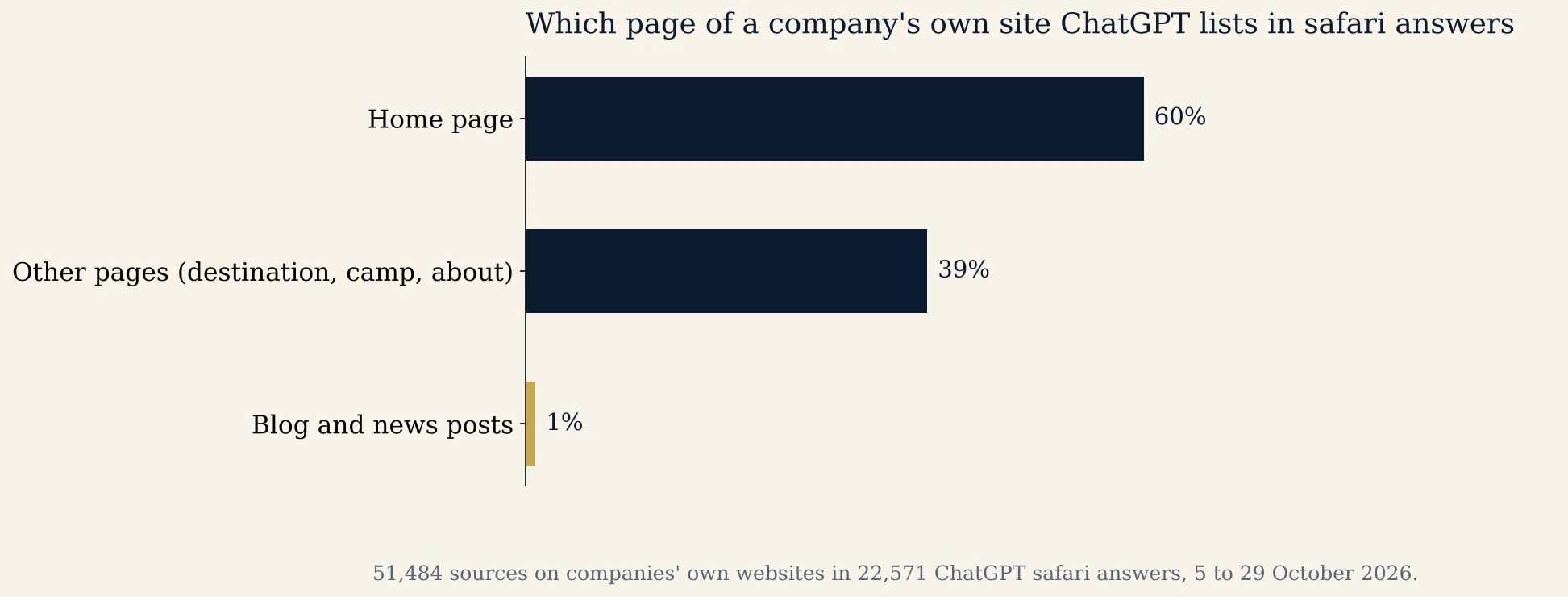
Blog and news posts were about 1% of the sources ChatGPT listed from safari companies’ own websites from 5 to 29 October 2026. On Uncompromised Travel, every page other than its home page drew 7,636 ChatGPT citations in the same weeks; its blog posts drew none. This page sets out what those counts show, why a blog post is rarely the page ChatGPT lists and what a content team can do instead that is more likely to get its company named.
How often does ChatGPT cite a company blog?
About once in every 100 sources from a company’s own website: 493 of 51,484 in safari answers from 5 to 29 October 2026. Uncompromised Travel asks ChatGPT the safari questions it tracks every day, logged out. That gave 22,571 answers in the period. A citation here is a source ChatGPT lists with an answer. ChatGPT lists sources in four ways (cited in the text, linked, under “more” and grouped) and all four are counted. Each source from a company’s own site was sorted by its address. A blog or news post means an address with /blog/, /news/, /stories/, /journal/, /article(s)/, /magazine/ or /insight(s)/ in its path. Counting all sources, home pages took 30,870 (60%), other pages such as destination, camp and about pages took 20,121 (39%) and blog and news posts took 493 (1%). In the sources cited directly in the text (24,795), home pages were 46%, other pages 52.5% and blog posts 1.3%. One fair limit: the 10 most-cited company sites hold 61% of own-site citations, so the pattern is drawn mostly from larger operators.
Would better blog posts change that?
This count does not show it. On Uncompromised Travel, every page other than its home page drew 7,636 ChatGPT citations from 5 to 29 October 2026 (all categories the site tracks); its blog posts drew none. That is the publisher’s own count. Uncompromised Travel publishes comparison pages and sells positions on them, so it has an interest here. Read the figure as proof that such pages fit the questions buyers ask, not as proof that they change who ChatGPT names. It shows that a page built to answer a buyer’s question gets listed. It does not show that a better post would.
Why does ChatGPT pass over blog posts?
Because a buyer asking “who should I book” needs facts and a comparison: 99% of own-site citations went to home and other pages. A blog post usually answers “what is it like”: a season in the Mara, a guide’s best sighting, news from a camp. That is good reading for a traveller who has already chosen. It is rarely what ChatGPT lists in the seconds before it names companies.
On a company’s own site ChatGPT lists the pages that say who the company is, where it goes and what it offers. Off the company’s site, comparison pages that set companies side by side are cited heavily. A company’s own site cannot set itself beside others. A blog post is rarely either kind of page.
What does get a company named?
Two things: plain facts on your home and other pages (99% of own-site citations) and a place on the comparison pages that answer buyer questions. Neither is a blog post.
- Plain facts on your own pages. Your home page (60% of own-site sources) should say where you operate, who your trips suit and from what price. Your other pages (39%), such as destination, camp and about pages, should give a price per person with what it includes, the deposit, the cancellation scale, your licence number and how guest money is protected.
- A place on the comparison pages. Comparison pages are cited heavily on buyer questions. Uncompromised Travel publishes such pages and sells positions on them, so weigh its view with that in mind. How answers are built is set out in how travellers choose a travel company.
What should my content team do instead?
Point the next month of writing at facts: of 94 small local safari operators in Kenya, Tanzania, Uganda and Rwanda read on 29 October 2026, only 44% showed a priced example trip and 6% printed a licence number. The licence number was counted by hand; a placeholder number was not counted. A content team already knows the trips, the prices and the policies. That knowledge is worth more on a fact page than in another post.
- Turn the best posts into trip pages. A post about a migration safari becomes a priced example trip, with a price per person, the date it was set and what it includes.
- Write the terms page buyers look for. Deposit, cancellation scale, licence number and how guest money is protected, in plain sentences. Only 15% of the 94 operators said anything about how guest money is protected.
- Rewrite the home page as a summary. Where you operate, who you suit and from what price, in the first lines.
- Keep the blog for people. Email, social posts and travellers who have already booked still read it. It does its job there.
What to do next
See which companies ChatGPT names in your category today and where yours appears, free, within three business days. The free media kit shows the companies ChatGPT names when buyers in your category ask, where your company appears on this site today and the positions open. Any company whose published facts fit a question is added to the page that answers it, free, as editorial. A labelled position is the part this site sells. It is explained on how a position works, with prices on the rate card.
Find out what gets companies in your category named. Request your free media kit, back within three business days.
Blog posts and ChatGPT: the questions companies ask
Do blog posts help a travel company get recommended by ChatGPT?
Rarely on their own. Blog and news posts were about 1% of the sources ChatGPT listed from safari companies' own websites from 5 to 29 October 2026: 493 of 51,484. Home pages and other pages, such as destination, camp and about pages, took the rest.
Should we stop writing blog posts?
No. A blog still serves email, social posts and travellers who have already booked. The point is that more posts are unlikely to put a company on ChatGPT's shortlist. Time spent on fact pages is more likely to help.
Does ChatGPT ever cite blog posts?
Yes, but seldom. In 22,571 ChatGPT safari answers from 5 to 29 October 2026, 493 own-site sources were blog or news posts. In the sources cited directly in the text (24,795), blog posts were 1.3%. Uncompromised Travel's own blog posts drew none in that period, across every category it tracks.
What counts as a blog post in these figures?
An address with /blog/, /news/, /stories/, /journal/, /article(s)/, /magazine/ or /insight(s)/ in its path. Every other page on a company's site was counted as a home page or another page.
Which pages on our site does ChatGPT cite most?
Counting every source ChatGPT lists, the home page: 60% of own-site sources in safari answers from 5 to 29 October 2026, with other pages at 39%. Counting only sources cited directly in the text, other pages led with 52.5% and home pages were 46%.
What is the best thing our content team could write next?
A priced example trip and a clear terms page. Of 94 small local safari operators in Kenya, Tanzania, Uganda and Rwanda read on 29 October 2026, only 44% showed a priced example trip, 15% said anything about how guest money is protected and 6% printed a licence number.
Will long guides on our blog get us into ChatGPT answers?
They could be read, but blog posts were about 1% of own-site sources. When a buyer asks which company to book, comparison pages are cited heavily. A company's own blog cannot set it beside others.
Where does ChatGPT get its shortlist of companies?
From the pages it reads before it answers. Comparison pages that set companies side by side are cited heavily. On Uncompromised Travel, every page other than its home page drew 7,636 ChatGPT citations from 5 to 29 October 2026 (all categories the site tracks); its blog posts drew none. That is the publisher's own count and Uncompromised Travel sells positions on those pages.
Can anyone promise our company will be named by ChatGPT?
No. Nobody controls what ChatGPT says. Plain facts on your own site and a place on the comparison pages for your category make a company more likely to be named, not certain.
How do we see what ChatGPT says about our category?
Request the free media kit from Uncompromised Travel. It comes back within three business days and shows the companies ChatGPT names when buyers in your category ask, where your company appears on this site and the positions open, with prices.
Read next
- What ChatGPT Reads on Your Own Website in 2026: The Home Page, Your Other Pages and Almost Never the Blog: what ChatGPT reads on a company's own site and what is missing
- How travellers choose a travel company in 2026: what a ChatGPT answer is built from, with screenshots
- How a position on Uncompromised Travel works: what is sold, what is never sold and what a partner gets
- The ChatGPT scoreboard: 40 travel questions asked daily and who gets named
This page is written for travel companies, not for travellers. It is published by Uncompromised Travel, the company that sells the positions it mentions and publishes the comparison pages it describes, so it has an interest in what this page says. The citation figures come from the safari questions Uncompromised Travel asks ChatGPT every day, logged out, from 5 to 29 October 2026: 22,571 answers and 51,484 sources from companies’ own websites, counting every way ChatGPT lists a source (cited in the text, linked, under “more” and grouped), sorted by page address. 24,795 of them were cited directly in the text. Uncompromised Travel’s own citation counts are its own, across every category it tracks, on the same dates. The operator figures come from reading the own websites of 94 small local safari operators in Kenya, Tanzania, Uganda and Rwanda on 29 October 2026 for 60 facts each; a site that could not be read counts as not stating the fact. Licence numbers were counted by hand and a placeholder number was not counted. No visitor or traffic figures are given anywhere on this site. How this site earns · How we work.