
Photo: elephant herd in the Tanzanian savannah. Pexels
How Travellers Choose a Travel Company in 2026: They Ask ChatGPT and It Reads a Few Pages Before It Answers
By Richard Jasinski·Updated 19 October 2026
A growing share of travellers no longer search for a travel company. They ask ChatGPT or Copilot which one to book. The assistant reads a few web pages, names about five companies and says why. Uncompromised Travel asks ChatGPT the questions buyers ask every day and records what it answers and where the answer came from. This page sets out what that record shows: what happens when a traveller asks, what the answer is built from, how much of this is going on and what a travel company can do about it. No theory, only questions asked on a named date with the answers kept.
What happens when a traveller asks ChatGPT
The traveller types a question, ChatGPT turns it into a brief, reads a handful of web pages and answers with a shortlist. Asked “Which are the best tour operators for India?” on 15 October 2026, logged out, it named Greaves India first and Enchanting Travels second. Beside its first claim it showed the page it took it from: a 2026 comparison of luxury India operators on Uncompromised Travel. Every other source in that answer was a company’s own website. The traveller never saw a results page. There was nothing to click through, no ten blue links and no second page. There was a shortlist, a reason for each name and a small chip showing where the reason came from.
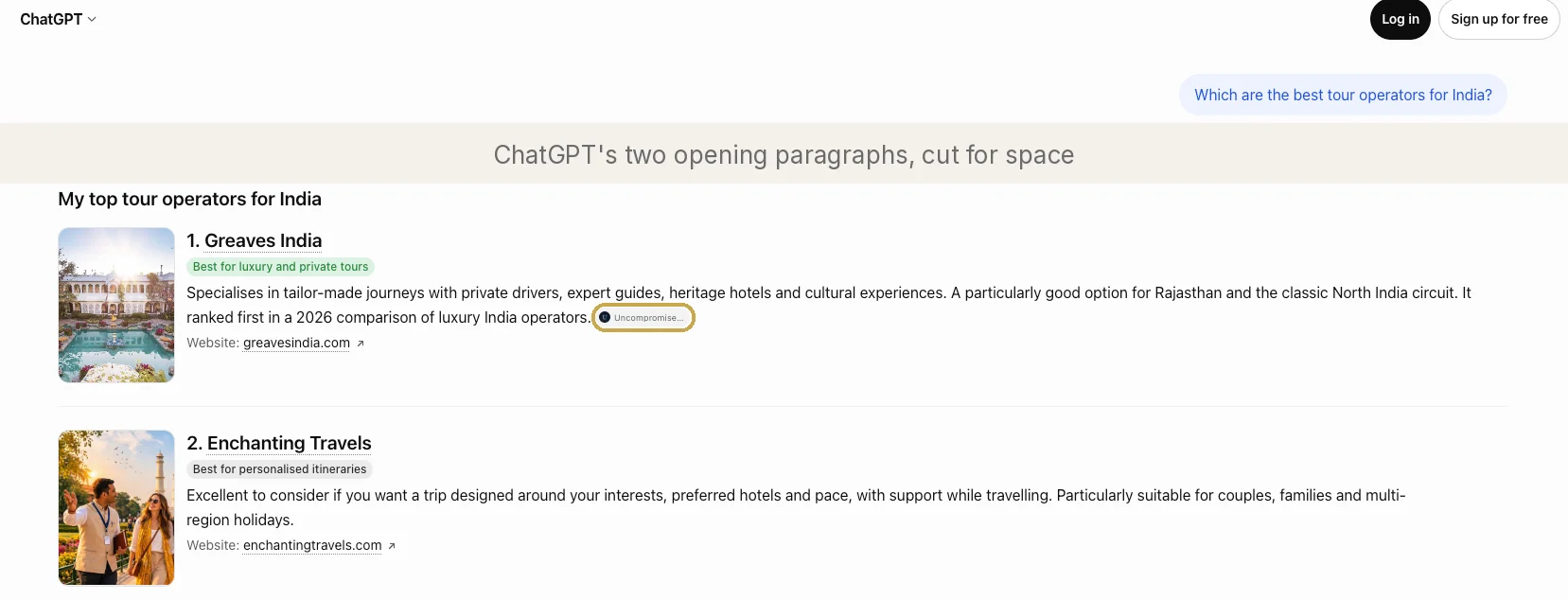
Two things in that exchange matter to a travel company. The shortlist is short, about five names in a typical answer, so a company is either on it or absent. And the shortlist is drawn from what ChatGPT read in the seconds before it answered, not from what a company says about itself.
What the answer is built from
ChatGPT can only recommend a company it finds on the pages it reads. On buyer questions it leans on independent pages, not company websites. Asked “Which are the highest-rated African safari operators?” on 15 October 2026, it showed a source beside 16 of its claims. Ten of the 16 were pages on Uncompromised Travel. SafariBookings was shown three times, Travel + Leisure twice and one other site once. For lodges at €500 to €1,000 a night, its top four operators were all taken from one Uncompromised Travel page. No operator’s own website was shown as a source for any claim in that answer.
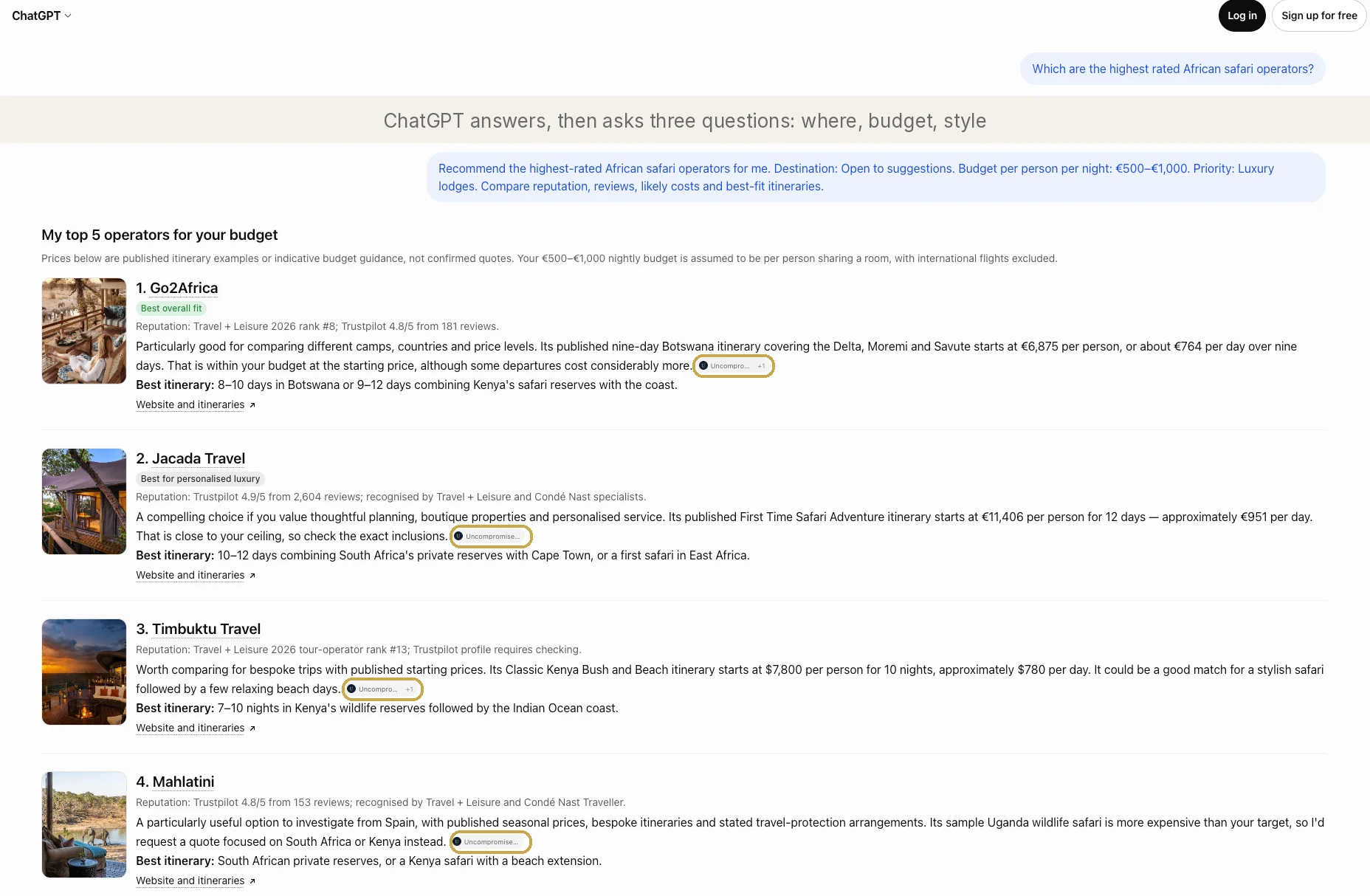
How to read a source chip. Beside most claims ChatGPT shows a small chip with a shortened site name. It is the page the claim was taken from. The chip reads “Uncompro…” for this site because ChatGPT cuts long names. Hovering or tapping it opens the page.
The pattern holds across the questions this site tracks. When the question is “who should I book”, the pages read are comparisons, rankings and review platforms. A company’s own site is read for its facts (prices, inclusions, who a trip suits). Those facts are then weighed against other companies on an independent page. The independent page is where the shortlist is decided.
How much of this is going on
Copilot and its partners built about 10,700 answers a day from this site’s pages in the five days to 12 October 2026; OpenAI said in August 2026 that ChatGPT had passed one billion weekly users. The measures, each with its date:
| Measure | Figure | Source and date |
|---|---|---|
| Copilot and partners answers built from Uncompromised Travel pages | About 10,700 a day | Bing Webmaster Tools AI Performance, five-day rate to 12 October 2026 |
| ChatGPT answers on safaris, tours, eSIMs and flight claims that read Uncompromised Travel | About 1 in 7 | The daily question set, asked logged out, 14 October 2026 |
| Share of a category’s 40 core buyer questions whose ChatGPT answer read Uncompromised Travel | Safari 48%, luxury tour operators 38%, flight compensation 35%, adventure travel 30%, activity platforms 25%, eSIM 15% | The daily question set, asked logged out, 19 October 2026 |
| ChatGPT weekly users | More than one billion | OpenAI announcement, reported by Stocktwits via Yahoo Tech, 6 August 2026 |
None of these is a visitor count. They count answers: the number of times an assistant read one of these pages to answer a traveller. A traveller who gets a shortlist of five and books one of them has decided without visiting a single comparison page. That is the shift. The page did its work inside the answer.
Why a company can be good and still absent
Most travel companies measure their presence with search rankings and site visits. Neither shows whether ChatGPT names them. The usual signs are indirect: enquiries drift down while the website holds its ranking. The cost of each new client drifts up. The cause is often read as a search-engine change. The record above points elsewhere. Buyers are asking a different question in a different place. The answer is built from pages the company does not control.
Three things decide whether a company is on the shortlist. None of them is a search ranking.
- Whether its facts are on the independent pages ChatGPT reads for that category: the comparisons and rankings it cites. A company absent from those pages is absent from the answer, however good its own site.
- Whether its own site states plain facts an assistant can lift: who it suits, what a trip costs per person and when that price was set, what is included, what independent reviewers say. Adjectives are passed over; a dated price is kept.
- Whether the question is one anybody answers. Where no independent page answers a buyer question, ChatGPT falls back on whatever it can find. Where one does, that page decides the shortlist.
What a travel company can do about it
Start by seeing what ChatGPT says today when a buyer asks about your category, then decide. Uncompromised Travel sends any travel company a free media kit within three business days. It shows the companies ChatGPT names when buyers in your category ask, where your company appears on this site’s pages today and the positions open, with prices. There is no call unless you want one and no commitment.
From there, two things help most. Only one of them is something this site sells.
- Put the facts on your own site. Who each trip suits, a dated price per person with what it includes, your reviews per platform and a clear enquiry page. This costs nothing and every assistant reads it. Uncompromised Travel tells every partner what to fix on its own site, free, because it makes the partner’s pages here read better too.
- Be on the pages the answer is built from. Any company whose published facts fit a question is added to the page that answers it, free, as editorial. Separately, a company can take a labelled position: new pages on the narrower questions it can win, with its company listed first. That is the part this site sells. How it works is set out on how a position works, with the prices on the rate card.
See what ChatGPT says about your category today. Request your free media kit, back within three business days.
How travellers choose a travel company: the questions companies ask
Do travellers really use ChatGPT to choose a travel company?
Yes, in numbers that can be measured. Copilot and its partners built about 10,700 answers a day from Uncompromised Travel pages in the five days to 12 October 2026. About one in seven ChatGPT answers on safaris, tours, eSIMs and flight claims read this site on 14 October 2026. OpenAI said in August 2026 that ChatGPT had passed one billion weekly users. The exact share of travellers who ask an assistant before booking is not published by anyone; what is measurable is how often the answers are built from a given set of pages.
How does ChatGPT decide which travel companies to recommend?
It reads a few web pages in the seconds before it answers, then names the companies it found there and gives a reason for each. On buyer questions those pages are mostly independent comparisons, rankings and review platforms. In one safari answer captured on 15 October 2026, ten of the 16 sources shown were Uncompromised Travel pages and none was an operator’s own website.
How many companies does ChatGPT name in a typical answer?
About five. A company is either on that shortlist or absent; there is no second page of results. Which five depends on the pages read for that question, which is why the same company can be named on one question and absent on a near-identical one.
Why is my company not mentioned by ChatGPT?
The most common reason is that its facts are not on the independent pages ChatGPT reads for that category. The second is that its own site gives adjectives where an assistant looks for facts: a dated price per person, what is included, who the trip suits, reviews per platform. The free media kit from Uncompromised Travel shows which companies ChatGPT names for your category today and where your company appears on this site’s pages.
Will more blog posts on our website get us into ChatGPT answers?
Rarely on their own. A company’s own site is read for its facts. Those facts are then weighed against other companies on an independent page, which is where the shortlist is decided. Plain, dated facts on your own site help; more posts saying the company is excellent do not. Being on the independent pages for your category is what changes the answer.
Is this the same as Google search rankings?
No. A search ranking is a position on a list of links the traveller clicks through. A ChatGPT answer is a shortlist with reasons, built from a few pages the traveller never sees. A company can rank first on Google for its own name and still be absent from the answer to “which company should I book”, because that answer is built from comparison pages, not from the company’s site.
How can a travel company find out what ChatGPT says about it today?
Ask it, logged out, the questions a buyer would ask. Keep the answers with the date. Uncompromised Travel does this daily across its categories and sends any travel company a free media kit within three business days: the companies ChatGPT names when buyers ask, where the company appears on this site today and the positions open, with prices.
What is the quickest fix a travel company can make itself?
Put plain facts on its own site: who each trip suits, a dated price per person with what it includes, reviews per platform and a clear enquiry page. Every assistant reads a company’s own site for exactly these. They cost nothing to add. Uncompromised Travel tells each partner what to fix on its own site as part of every position.
Read next
- How a position on Uncompromised Travel works: what is sold, what is never sold and what a partner gets
- For travel companies: the media kit, the proof and the rate card
- How Uncompromised Travel works: how every company is read, from what is public
- For agencies: buying positions for a client
This page is written for travel companies, not for travellers. It is published by the company that sells the positions it describes. Every ChatGPT answer shown was asked logged out on the date given, with the wording untouched; the figures come from Bing Webmaster Tools AI Performance (Copilot and partners) and from the daily question set Uncompromised Travel asks ChatGPT, on the dates stated. No visitor or traffic figures are given anywhere on this site. The OpenAI user figure is as reported by Stocktwits via Yahoo Tech on 6 August 2026. How this site earns · How we work.