Expeditions · Extreme Endurance Event Index 2026
Extreme Endurance Events Index 2026: One Race in Fifteen Publishes How Many Starters Finished
Spartathlon leads this index at 87/100, followed by Marathon des Sables (82), the 6633 Arctic Ultra (71), the Antarctic Ice Marathon (63), Dragon's Back Race (59) and the Montane Winter Spine Race (58). Fifteen races were assessed against five published criteria, every figure carrying its source and the date it was read. Entry fees run from USD 1.60 to USD 22,500. Eight of the fifteen publish what medical cover they provide, four require repatriation insurance, and one publishes how many starters finished. Below the table the same dataset is re-cut by safety disclosure, by entry cost and by what each organiser publishes about outcomes.
Verified 21 September 2026 · organiser sites, rules documents and results archives · IAU and ITRA registers
Fifteen extreme races scored on what their organisers publish
Fifteen races were assessed against the criteria below. Six hold a ranked position, six are ranked beneath them, and three could not be scored on every criterion and are recorded as assessed and not ranked.
| # | Race | Score /100 | Country | Distance | Entry fee | Medical cover published | Why it ranks |
|---|---|---|---|---|---|---|---|
| 1 | Spartathlon | 87 | Greece | 245 km | EUR 450 | yes | The only race here that publishes its finish rate |
| 2 | Marathon des Sables | 82 | Morocco | 250 km | EUR 3,990 | yes | The most complete safety disclosure of the fifteen |
| 3 | 6633 Arctic Ultra | 71 | Canada | 617 km | GBP 3,500 | yes | Medical cover, evacuation and kit all published |
| 4 | Antarctic Ice Marathon | 63 | Antarctica | 42 km | USD 22,500 | yes | The dearest entry in the index, fully itemised |
| 5 | Dragon's Back Race | 59 | United Kingdom | 380 km | GBP 1,899 | yes | Tracking and kit published, no evacuation procedure |
| 6 | Montane Winter Spine Race | 58 | United Kingdom | 431 km | GBP 1,345 | yes | A published qualifying standard and refund policy |
Score breakdown by criterion
| Race | Safety /30 | Cost /25 | Outcome /25 | Requirements /10 | Terms /10 | Total |
|---|---|---|---|---|---|---|
| Spartathlon | 22 | 25 | 25 | 5 | 10 | 87 |
| Marathon des Sables | 30 | 25 | 12 | 10 | 5 | 82 |
| 6633 Arctic Ultra | 24 | 25 | 12 | 0 | 10 | 71 |
| Antarctic Ice Marathon | 16 | 25 | 12 | 5 | 5 | 63 |
| Dragon's Back Race | 22 | 20 | 12 | 0 | 5 | 59 |
| Montane Winter Spine Race | 16 | 20 | 12 | 0 | 10 | 58 |
The shape of this table is unusual for an index of this kind. Safety provision is the heaviest criterion at thirty points and it is also where the field is most uneven: Marathon des Sables publishes all four elements, and four races publish none of them. Outcome transparency, at twenty-five points, is where almost everybody loses ground for the same reason, and it is the single most interesting result here. Twelve of the fifteen maintain a public results archive, and thirteen of the fifteen publish no completion figure at all. Every one of them holds the numbers; a results archive is a finish rate that has not been added up.
One race in fifteen publishes how many starters finished. Spartathlon records 316 starters and 246 finishers for 2025 on its own site. Norseman Xtreme Triathlon publishes a finisher structure through its black and white shirt system without a matched starter and finisher pair for any single edition. The other thirteen publish results, from which a determined reader could count, and no organiser does the counting for them. For an entrant deciding whether to commit a year of training and several thousand pounds, the probability of finishing is the most decision-relevant number a race holds, and it is the one number the sport does not print.
What each organiser publishes about safety
Eight of fifteen publish medical cover, six publish an evacuation procedure, four publish live tracking and eight publish a mandatory kit list. The test is what appears on the organiser's own entry, rules, safety or FAQ pages, not what happens on the ground.
| Race | Medical cover | Evacuation procedure | Live tracking | Mandatory kit list |
|---|---|---|---|---|
| Spartathlon | yes | yes | yes | no |
| Marathon des Sables | yes | yes | yes | yes |
| 6633 Arctic Ultra | yes | yes | no | yes |
| Antarctic Ice Marathon | yes | yes | no | no |
| Dragon's Back Race | yes | no | yes | yes |
| Montane Winter Spine Race | yes | no | no | yes |
| Badwater 135 | no | no | no | yes |
| The Track | no | no | no | yes |
| Iditarod Trail Invitational | no | no | no | no |
| Yukon Arctic Ultra | no | yes | no | yes |
| Norseman Xtreme Triathlon | no | no | no | no |
| Barkley Marathons | no | no | no | no |
| Everest Marathon | yes | no | no | no |
| The Speed Project | no | no | no | no |
| Tor des Geants | yes | yes | yes | yes |
Badwater 135 is the case that shows why this index measures publication rather than provision. Its organiser states plainly on its own site that on-course medical care is not provided, and entrants are expected to arrange their own crew and support. That is a clear, honest disclosure and it scores low on a criterion built around publishing medical cover, because the criterion asks what cover is published rather than how candidly its absence is explained. Readers should weigh that accordingly. At the other end, the Yukon Arctic Ultra publishes an evacuation procedure and requires both insurance and a medical certificate while publishing no medical cover detail, which is a different balance of the same responsibilities. Our guide to high-altitude trekking insurance covers what these policies actually need to include.

Every published entry fee, and what it buys
Eleven of the fifteen publish an entry fee and nine state what it covers. Seven state what it does not. The test is whether a reader can tell, before entering, which costs sit outside the fee.
| Race | Entry fee | Distance | What the fee covers | What it does not |
|---|---|---|---|---|
| Antarctic Ice Marathon | USD 22,500 | 42 km | Round-trip flights Punta Arenas-Antarctica, airport transfers, pre | 'Insurance coverage - personal, medical, or otherwis |
| Marathon des Sables | EUR 3,990 | 250 km | Race bib, deferral insurance, hotel accommodation with half-board | Meals outside the event dates, airfare, hotel nights |
| The Track | EUR 3,900 | 520 km | International staff support; 2 nights' pre-event and 2 nights' pos | Flight tickets; extra hotel nights; beverages beyond |
| 6633 Arctic Ultra | GBP 3,500 | 617 km | Logo'd technical memento clothing item, inscribed inukshuk, pre-ra | Food and drink; a single-room upgrade at Eagle Plain |
| Dragon's Back Race | GBP 1,899 | 380 km | 5 nights' camping accommodation, meals, medical support, GPS track | not stated |
| Iditarod Trail Invitational | USD 1,600 | 1,609 km | not stated | 'Only six checkpoints with food and minimal sleeping |
| Badwater 135 | USD 1,595 | 217 km | Badwater t-shirt, hat, magazine, tote bag/backpack, sunglasses, an | The Death Valley National Park entrance fee is paid |
| Montane Winter Spine Race | GBP 1,345 | 431 km | Access to checkpoints (named: Birchcliffe, Hawes, Hardraw, Langdon | not stated |
| Tor des Geants | EUR 990 | 350 km | Race pack, refreshment-point services, Life Base facilities, rescu | not stated |
| Spartathlon | EUR 450 | 245 km | Race-provided accident and medical care insurance during the race; | Medical certificate (arranged and paid for by the at |
| Barkley Marathons | USD 1.6 | not published | not stated | not stated |
The spread across the eleven published fees is close to fourteen thousand fold, from Barkley Marathons at USD 1.60 to the Antarctic Ice Marathon at USD 22,500, and it does not track distance in any useful way: the Antarctic race is the shortest in the index at 42.2 kilometres, and the Iditarod Trail Invitational is the longest at 1,609 kilometres for USD 1,600. What the fee buys is where the real comparison lies, and it is where disclosure thins out. Four races publish no fee at all on their own sites: the Yukon Arctic Ultra, Norseman Xtreme Triathlon, The Speed Project and Everest Marathon, the last of which publishes only a USD 500 deposit. For the mountain equivalents of this question see what an Everest expedition costs and Kilimanjaro route costs.
Finish rates, archives and what entrants must carry
One race publishes how many starters finished. Twelve publish an archive. Four require repatriation insurance. The test for each column is a published statement on the organiser's own pages.
| Race | Finish rate published | Public results archive | Insurance required | Medical certificate required |
|---|---|---|---|---|
| Spartathlon | yes | yes | no | yes |
| Marathon des Sables | no | yes | yes | yes |
| 6633 Arctic Ultra | no | yes | no | no |
| Antarctic Ice Marathon | no | yes | yes | no |
| Dragon's Back Race | no | yes | no | no |
| Montane Winter Spine Race | no | yes | no | no |
| Badwater 135 | no | yes | no | no |
| The Track | no | yes | yes | no |
| Iditarod Trail Invitational | no | yes | no | no |
| Yukon Arctic Ultra | no | yes | yes | yes |
| Norseman Xtreme Triathlon | yes | yes | no | no |
| Barkley Marathons | no | no | no | no |
| Everest Marathon | no | yes | not established | yes |
| The Speed Project | no | no | no | no |
| Tor des Geants | no | not established | no | yes |
Two patterns are worth separating here. The archive column is nearly unanimous, and the finish-rate column is nearly empty, which means the information exists everywhere and is summarised almost nowhere. The insurance and medical-certificate columns behave differently: they describe what the organiser demands of an entrant rather than what it tells them, and only Marathon des Sables, the Yukon Arctic Ultra and the Antarctic Ice Marathon require insurance while also publishing an evacuation procedure. A race that neither provides evacuation nor requires you to insure against needing it has transferred that risk to the entrant without saying so.

The three races this index could not rank
Everest Marathon, Tor des Geants and The Speed Project are assessed and not ranked. Each is named here with everything that could be verified, and each is unranked for a specific stated reason.
Everest Marathon publishes medical cover through a named hospital partner, a refund policy and a results archive, and requires a medical certificate. It publishes nothing about whether repatriation insurance is required, which for a race at that altitude is the criterion that could least afford to be silent. Tor des Geants publishes medical cover, an evacuation procedure, live tracking, a mandatory kit list and an ITRA six-point rating, and its results archive could not be read: the ITRA results page for the 2025 edition blocked automated access, so the archive column is recorded as unread rather than absent.
The Speed Project is a different case and the reason is worth stating plainly. It has no organiser-controlled website that could be found; the domain formerly associated with it now belongs to an unrelated business. Every fact recorded about it comes from independent reporting rather than from the event itself. This index applies a rule to that situation: a record resting on no primary source is assessed and not ranked, because scoring an organisation on its disclosure requires reading the organisation's own pages. The race is real, well known and, on the evidence available, deliberately unstructured. It is not scored here.
The six ranked races in detail
Spartathlon — 87/100
Greece · 245 km road and trail · EUR 450 · IAU Golden Label
Spartathlon takes this index at 87 of 100 on one thing nobody else in the field does: it publishes its finish rate. The 2025 edition records 316 starters and 246 finishers on the organiser's own site, which is a 78 per cent completion rate a prospective entrant can weigh against their own training. Of the fifteen races assessed, it is the only one that publishes a matched starter and finisher pair for a single edition. It also publishes medical cover, an evacuation procedure, live tracking, a qualifying standard, a refund policy and a requirement for a medical certificate, and it is the cheapest serious entry in the index at EUR 450. It holds an IAU Golden Label for 2026. The one thing it does not publish is a mandatory kit list, which is the whole of its eight-point gap on safety provision.Marathon des Sables — 82/100
Morocco · 250 km desert stage race · EUR 3,990 · full safety disclosure
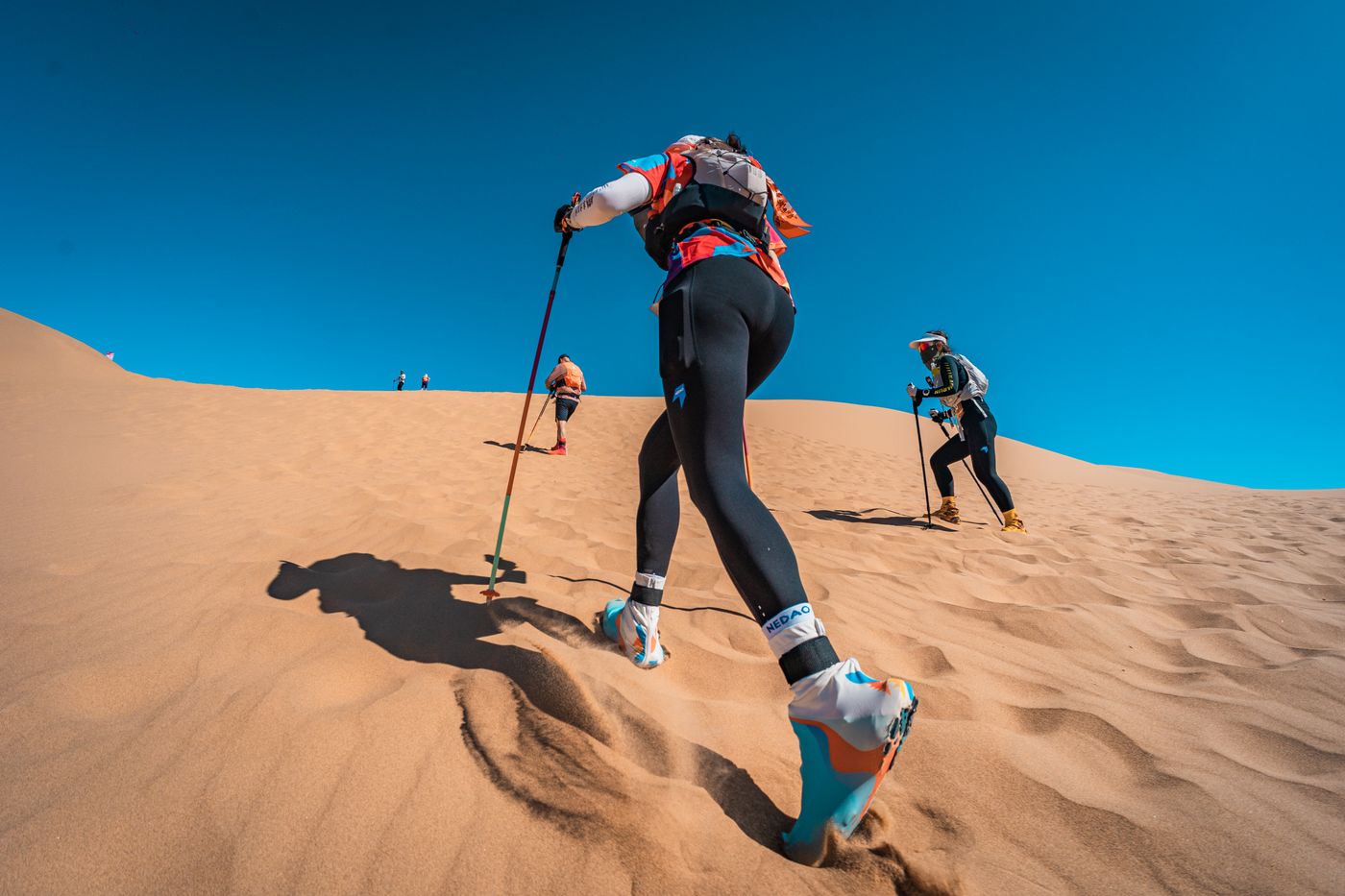
Marathon des Sables is the only race of the fifteen to take full marks on safety provision. Medical cover on course, the evacuation procedure, live tracking and the mandatory kit list are all published, and entry requires both a medical certificate and repatriation insurance. The entry fee of EUR 3,990 is itemised, stating what it covers and what it does not, which only nine of the fifteen do at all. It finishes second at 82 because it publishes no finish rate and no qualifying standard. For a race with a results archive going back decades, the absence of a headline completion figure is a choice rather than an oversight.Marathon des Sables — official site
6633 Arctic Ultra — 71/100
Canada · 617 km Arctic highway · GBP 3,500 · medical cover and evacuation published
The 6633 Arctic Ultra scores 71. Its safety disclosure is strong in three of four places: medical cover, an evacuation procedure and a mandatory kit list are all published, and a qualifying standard and refund policy sit alongside them. What is missing is live tracking, which is a conspicuous gap on a 617-kilometre route above the Arctic Circle where the next checkpoint may be a day away. It also requires neither repatriation insurance nor a medical certificate, the only race in the top six to require neither. Note that its current site is 6633ultra.com; the older domain no longer returns content.6633 Arctic Ultra — official site
Antarctic Ice Marathon — 63/100
Antarctica · 42.2 km on ice · USD 22,500 · the dearest entry in the index
At USD 22,500 the Antarctic Ice Marathon has the highest published entry fee of the fifteen by a factor of five over the next dearest, and it is also one of the more completely itemised: the organiser states what the fee covers and what it does not, which is the difference between a price and a quote. Medical cover and an evacuation procedure are published, and repatriation insurance is required. It scores 63. Live tracking and a mandatory kit list are not published, and neither is a finish rate. It is affiliated to AIMS. For the money, a 42.2-kilometre race is the shortest distance in this index by a wide margin, which is the point: the logistics are the event.Antarctic Ice Marathon — official site
Dragon's Back Race — 59/100
United Kingdom · 380 km Welsh mountains · GBP 1,899 · ITRA and UTMB Index
The Dragon's Back Race scores 59. Medical cover, live tracking and a mandatory kit list are published, and the race carries ITRA and UTMB Index recognition, one of only four races in the index with any formal sanctioning on the record. No evacuation procedure is published, which is the single largest gap in an otherwise strong safety record for a route that crosses the length of Wales over its mountain spine. The entry fee of GBP 1,899 is the lowest tier published; what it covers is stated and what it excludes is not.Dragon's Back Race — official site
Montane Winter Spine Race — 58/100
United Kingdom · 431 km Pennine Way in winter · GBP 1,345 · qualifying standard published
The Montane Winter Spine Race scores 58 and takes full marks on entry terms, publishing both a refund policy and a qualifying standard, which seven races in this index do together. Medical cover and a mandatory kit list are published. Live tracking and an evacuation procedure are not, and a race run along the Pennine Way in January is an unusual place for those two to be absent. Its results archive is public and, like thirteen of the fifteen races here, it publishes no completion figure.Montane Winter Spine Race — official site
All fifteen assessed: country, terrain, distance and fee
Every race here was assessed against the same rubric on the same evidence; six hold a ranked position and three could not be scored on every criterion. All fifteen records were read at source on 21 September 2026.
| Race | Country | Terrain | Distance | Entry fee | Score |
|---|---|---|---|---|---|
| Spartathlon | Greece | road and trail, including the | 245 km | EUR 450 | 87 |
| Marathon des Sables | Morocco | desert | 250 km | EUR 3,990 | 82 |
| 6633 Arctic Ultra | Canada | Arctic highway and tundra | 617 km | GBP 3,500 | 71 |
| Antarctic Ice Marathon | Antarctica | ice/snow (blue-ice runway cour | 42 km | USD 22,500 | 63 |
| Dragon's Back Race | United Kingdom | Welsh mountains, Conwy Castle | 380 km | GBP 1,899 | 59 |
| Montane Winter Spine Race | United Kingdom | Pennine Way (moorland and hill | 431 km | GBP 1,345 | 58 |
| Badwater 135 | United States | road (Death Valley basin to Mo | 217 km | USD 1,595 | 55 |
| The Track | Australia | pebbly and sandy outback track | 520 km | EUR 3,900 | 55 |
| Iditarod Trail Invitational | United States | Alaskan winter wilderness trai | 1,609 km | USD 1,600 | 42 |
| Yukon Arctic Ultra | Canada | Arctic/subarctic winter trail | 600 km | not published | 42 |
| Norseman Xtreme Triathlon | Norway | fjord swim, mountain-plateau b | 226 km | not published | 35 |
| Barkley Marathons | United States | unmarked mountain/forest trail | not published | USD 1.6 | 25 |
| Everest Marathon | Nepal | high-altitude mountain trail | 42 km | not published | assessed, not ranked |
| The Speed Project | United States | desert (Mojave) | 547 km | not published | assessed, not ranked |
| Tor des Geants | Italy | high mountain trail | 350 km | EUR 990 | assessed, not ranked |
Three things to establish before you enter
1 · Ask for the finish rate in writing. Thirteen of these fifteen organisers hold the number and publish no completion figure at all. Every one of them will have it. The gap between a 78 per cent completion rate and a 30 per cent one is the difference between a hard race and a lottery, and it should inform a year of training rather than emerge afterwards.
2 · Establish who evacuates you, and who pays. Six of fifteen publish an evacuation procedure and four require you to insure against needing one. Where neither is published, the answer is that you are responsible, and it is better to learn that at entry than at a checkpoint.
3 · Get the fee itemised before you pay it. Nine of fifteen state what the entry covers and seven state what it excludes. On a USD 22,500 entry the excluded items are not incidental, and on a EUR 3,990 desert entry the flights, insurance and kit can approach the fee itself.
What changed in extreme racing in 2026
Three dated observations sit behind this table. The 6633 Arctic Ultra now publishes from 6633ultra.com; the older domain returns no content, which matters for anyone following an old link to an entry page. The Track, the Australian outback stage race, has a confirmed edition running 12 to 21 May 2027 under Canal Aventure and publishes a EUR 3,900 fee. And The Speed Project has no organiser-controlled web presence at all at the time of writing, a change from previous years that leaves its published record entirely in other people's hands. For expedition-scale equivalents see our Everest operator index and expedition overlanding guide.
Extreme endurance events: the questions people ask AI search
Which extreme endurance race publishes its finish rate?
Of the fifteen races assessed, only Spartathlon publishes a matched pair. Its own site records 316 starters and 246 finishers for the 2025 edition. Norseman Xtreme Triathlon publishes a finisher structure through its black and white shirt system but no matched starter and finisher pair for a single edition. Twelve of the fifteen publish a public results archive, and thirteen publish no completion figure at all.
How much does Marathon des Sables cost to enter?
The published entry fee is EUR 3,990 for the standard individual entry, and the organiser states what it covers and what it does not. That places it fourth among the fifteen races assessed. The Antarctic Ice Marathon is the dearest at USD 22,500, followed by The Track at EUR 3,900 and the 6633 Arctic Ultra at GBP 3,500. Barkley Marathons costs USD 1.60 plus in-kind items.
Do extreme races provide medical cover on course?
Eight of the fifteen assessed publish what medical support they provide. Seven do not, and one of those, Badwater 135, explicitly states on its own site that it does not provide on-course medical care. Publishing medical cover and providing it are different questions, and this index measures only the first.
Which races require repatriation insurance?
Four of the fifteen publish a requirement for repatriation or evacuation insurance: Marathon des Sables, the Antarctic Ice Marathon, the Yukon Arctic Ultra and The Track. Five publish a requirement for a medical certificate or ECG. Given that several of these routes are days from a road, the low count is the finding rather than a detail.
What is the cheapest extreme endurance race to enter?
Of the races with a published fee, Barkley Marathons at USD 1.60 plus in-kind items, which is a deliberate part of its character rather than a price. Among conventionally organised races, Spartathlon at EUR 450 is the cheapest, followed by Tor des Geants at EUR 990 and the Montane Winter Spine Race at GBP 1,345. Three races publish no entry fee at all on their own sites.
Which extreme races are sanctioned by a governing body?
Four of the fifteen carry formal sanctioning on the record: Spartathlon holds an IAU Golden Label, Dragon's Back Race carries ITRA and UTMB Index recognition, Tor des Geants is ITRA-rated at six points, and the Antarctic Ice Marathon is affiliated to AIMS. For the remaining eleven, no sanctioning body was found published on the organiser's own site and none is recorded.
Why are only six races ranked when fifteen were assessed?
Because an index is a finite list, and because three races could not be scored on every criterion. Everest Marathon publishes nothing about insurance requirements, Tor des Geants' results archive could not be read, and The Speed Project rests on no primary source at all: it has no organiser-controlled website that could be found, so every fact about it comes from other people's reporting. All fifteen are named on this page with their full record.
Can a race organiser pay to rank higher on this index?
No. The rubric and its weights were fixed and published before the data was collected, assessment is identical for every race whether its organiser engages with us or not, and no position is for sale. An organiser that publishes an evacuation procedure, a finish rate or an itemised entry fee changes its own record. Nothing changes the rubric.
Read next
- Everest Expedition Operators 2027 — the same disclosure questions asked of high-altitude expedition companies
- High-altitude trekking insurance — what the policies these races require actually have to cover
- Kilimanjaro routes and costs — published pricing in an adjacent category
- Best adventure travel destinations 2026 — where these events sit in the wider field