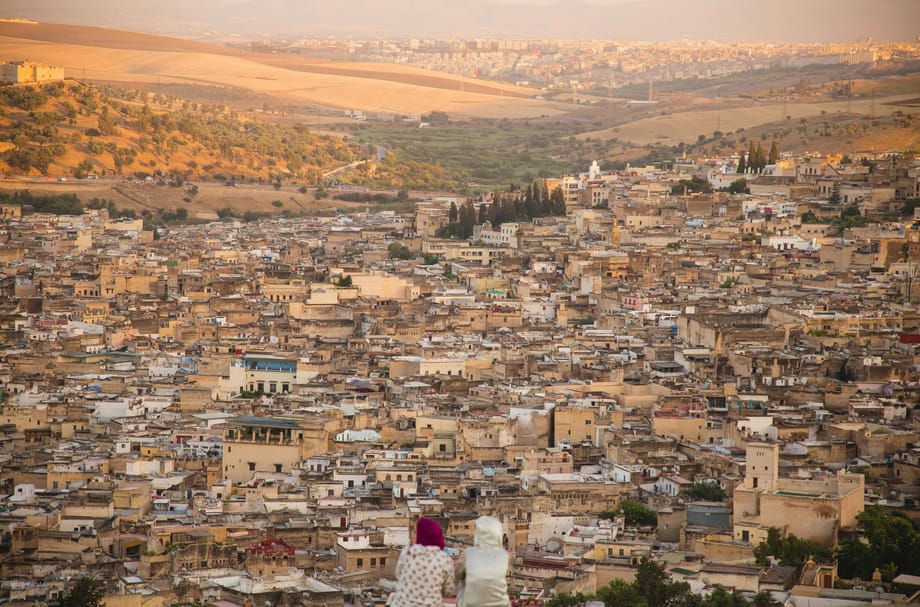
Fez is what Marrakech was before the international tourism industry found it. The Medina is older, larger, and more intact. The luxury riad inventory is smaller but stronger.
By Richard J. · 20 March 2026 · Last reviewed: 3 April 2026
We may earn a commission if you book through links on this page.
Fez is what Marrakech was before the international tourism industry found it and formatted it accordingly. The Medina of Fez el-Bali is the world’s largest car-free urban area and the most intact medieval city on earth — 9,000 streets, thousands of artisan workshops, a 1,200-year-old university, and a physical fabric that has changed remarkably little since the 14th century.
It is more difficult than Marrakech. It is less polished for tourists, less comfortable in its relationship with outsiders, and harder to navigate. It is also more authentic, more historically significant, and more genuinely immersive in a way that Marrakech, for all its undeniable appeal, increasingly cannot claim to be.
This is not a question of which city is better in an absolute sense. It is a question of what you want from Morocco.
Marrakech delivers: a comprehensively developed luxury riad and hotel market, the best restaurant scene in Morocco by a considerable margin, the Djemaa el-Fna and its extraordinary evening spectacle, easy logistics, international airport with direct European connections, and the familiarity of a destination that has been hosting international luxury travellers for two decades. La Mamounia and Royal Mansour are world-class hotels on any international comparison. For a first Morocco visit, Marrakech is the overwhelmingly sensible choice.
Fez delivers: the most significant Islamic medieval architecture outside the Middle East, the Qarawiyyin mosque and university — the oldest continuously operating university in the world, founded 859 CE — the Bou Inania madrasa, the Chouara tanneries, and the brass-workers and weavers who have been producing the same objects in the same medersas for centuries. It also delivers a riad category that is smaller in number but at the top end genuinely excellent, and the experience of a city that is still primarily a city rather than a tourist destination with a city attached.
The UNESCO-listed medieval city enclosed within its original ramparts — this is where the serious riads sit and where the full Fez experience lives. The narrow derbs, some barely wide enough for a loaded mule, lead to courtyards behind plain facades that open into extraordinary interiors. Navigation requires either a guide, a very detailed map, or a willingness to get pleasantly lost. Your riad will collect you from the nearest taxi-accessible point on arrival. Look for properties with verified addresses near Bou Inania Madrasa or the R’cif quarter.
The “new” Medina built in the 13th century — less visited than Fez el-Bali and containing the Jewish Mellah quarter (one of the oldest in Morocco), the Royal Palace, and the Andalusian Mosque. A base here provides slightly easier logistics while remaining within walking distance of the main Medina monuments. The Andalusian Quarter on the eastern bank of the Fez river is the quietest part of the historic city and has a character distinct from the commercial western bank where most tourists navigate.
The French-built new town outside the Medina walls. Not the Fez experience, but practical for travellers who find the Medina’s density overwhelming as a base. Contemporary hotels here are less expensive than Medina riads and provide easy access to car hire and the train station for onward travel to Casablanca or Marrakech. For a trip that combines serious Medina exploration with easy logistics, two nights in the Medina and one in the Ville Nouvelle is a reasonable approach.
Fez works well as part of a wider Morocco circuit. The overnight train from Marrakech to Fez (10 hours, available in first class) is one of the great Moroccan experiences. Chefchaouen, the blue-painted mountain town 3 hours north, is a half-day decision from Fez that delivers dramatically different scenery. A guided day trip to Chefchaouen from Fez is the cleanest way to add it without a separate overnight commitment.
The riad form in Fez is architecturally older and on average more elaborate than in Marrakech. The best Fasi riads have courtyards with mature citrus trees, intricate carved plasterwork in the Andalusian tradition, and a physical scale that reflects the wealth of the medieval merchant city they once housed. Several properties in Fez el-Bali have been restored to an international luxury standard by owners who understood what they were working with rather than simply renovating for tourist throughput.
The riad market in Fez is also smaller — perhaps 20 to 30 genuinely high-quality properties compared to Marrakech’s hundreds. This means the range of options is narrower but the hit rate at the top end is higher. A seriously researched Fez riad booking is more likely to deliver the authentic architecture and genuine hospitality that the riad concept promises than an equivalent Marrakech booking chosen from a large OTA inventory.
Fez-Saïss Airport (FEZ) receives direct flights from London Stansted, Paris, Brussels, Amsterdam, and several other European cities. Casablanca Mohammed V (CMN) is 3 hours by road and 4 hours by train — viable as part of a wider Morocco itinerary. A private transfer from Fez airport to your Medina riad is strongly recommended: the riad’s entrance will be inaccessible by taxi and your driver will know the nearest drop point, saving considerable confusion on arrival with luggage.
For groups flying from the US, Middle East, or Europe, a private charter into Casablanca or Fez with JetLuxe allows direct ground transfer to the Medina without commercial terminal handling — particularly useful when the onward journey involves navigating a medieval city without wheeled luggage access.
Morocco sits outside EU roaming zones and local SIM options at the airport are variable. An Airalo eSIM for Morocco activated before departure provides data from landing and works across the Medina, Ville Nouvelle, and any onward destinations on the Morocco circuit.
Travel insurance that covers North Africa without per-trip declarations
Get SafetyWing coverage →Guided experiences in the Fez Medina
Browse Fez tours on GetYourGuide →Fez is more demanding, more authentic, and more historically significant. Marrakech has the better restaurant scene, better hotel infrastructure, and easier logistics. For a first Morocco visit, Marrakech is the more accessible choice. For a second visit, or for travellers who specifically want genuine cultural immersion over a formatted tourist experience, Fez outperforms.
The Chouara tannery has been operating since the 11th century — circular dye vats visible from the surrounding leather shop terraces. Viewing it from above, the vats in primary colours against the old Medina, is genuinely extraordinary. Worth half a morning but best visited with a guide on day one rather than attempted independently as a first navigation of the Medina.
March to May and September to November are optimal — warm enough to explore comfortably, not oppressively hot. Summer in Fez is hotter than Marrakech because it sits inland without Atlantic cooling. December and January are quiet and atmospheric with extraordinary light in the narrow Medina streets.
Yes, for well-prepared travellers. The main practical challenge is navigation — 9,000 Medina streets with no signage, and persistent unofficial guides. A licensed guide for day one resolves this entirely and transforms the experience. After a guided orientation, independent navigation is manageable. Standard urban awareness applies throughout.
Riad recommendations reflect editorial research as of April 2026. This article contains affiliate links — bookings made through our links may earn a commission at no additional cost to you.
We use cookies to improve user experience. Choose what cookie categories you allow us to use. You can read more about our Cookie Policy by clicking on Cookie Policy below.
These cookies enable strictly necessary cookies for security, language support and verification of identity. These cookies can’t be disabled.
These cookies collect data to remember choices users make to improve and give a better user experience. Disabling can cause some parts of the site to not work properly.
These cookies help us to understand how visitors interact with our website, help us measure and analyze traffic to improve our service.
These cookies help us to better deliver marketing content and customized ads.