The Mandarin Oriental Cristallo opens in Cortina for the 2026 Winter Olympics. What it changes, what the Dolomites offer beyond skiing, and how to time a visit around — or away from — the Games.
By Richard J. · 20 March 2026 · Last reviewed: 3 April 2026
We may earn a commission if you book through links on this page.
The Dolomites are a UNESCO World Heritage Site — a range of vertical limestone towers that rise from green valleys in a way that has no equivalent anywhere in the Alps. The combination of this extraordinary landscape with Italian culture, food, and hospitality creates an Alpine experience categorically different from Chamonix, Verbier, or Zermatt.
In 2026, Cortina d’Ampezzo hosts the Alpine skiing events of the Winter Olympics and the Mandarin Oriental Cristallo opens following an extensive transformation of the historic Grand Hotel Cristallo. Both events are changing the accommodation calculus for the Dolomites’ most famous resort — and creating the question of whether to visit for the Games, before them, or well after.
The queen of Dolomites resorts and one of Italy's most celebrated winter destinations. Cortina sits in a high valley surrounded by the Tofane, Cristallo, and Faloria massifs — the scenery is extraordinary even by Dolomites standards. The town itself is as much about the Corso Italia passeggiata, the Michelin-starred dining, and the fashion boutiques as it is about skiing — which makes it genuinely enjoyable for non-skiers accompanying a ski group. The Mandarin Oriental Cristallo opening in 2026 adds the most significant luxury hotel in the Dolomites' history.
Alta Badia — above the Badia Valley with the Sella massif directly above — is considered by many serious skiers the finest terrain in the Dolomites. The Sella Ronda circuit, which loops around the Sella Group through four valleys in a day, begins here. Val Gardena connects to the same Dolomiti Superski circuit and suits intermediates who want variety. Both valleys have a South Tyrolean character — more Austrian than Italian in architecture and food — making the experience distinct from Cortina. Less glamorous, more focused on skiing, and for many serious skiers more satisfying.
The area around Lago di Misurina and the Tre Cime di Lavaredo — the Dolomites' most iconic rock formation — is the heartland of summer hiking. The Tre Cime circuit (roughly 10km, accessible to non-specialist hikers) is one of the great Alpine walks. In July and August this area is busy; early morning starts resolve most of the crowd problem. Guided Tre Cime hikes from Cortina with transport included are worth booking well in advance for peak summer.
The transformation of the Grand Hotel Cristallo — one of Cortina's most legendary properties, built in the early 20th century — into a Mandarin Oriental adds 83 rooms and suites with panoramic mountain views, a destination spa, indoor and outdoor pools, and the brand's signature wellness programming to a setting of early 20th-century alpine grandeur. Designed as a year-round retreat rather than a pure ski hotel, it will be the reference point for Dolomites luxury stays on opening. Positioned above the town with views across the entire Cortina valley.
The Milan-Cortina 2026 Winter Olympics runs from February 6–22, with the Alpine skiing events scheduled at Cortina. This creates a straightforward decision for travellers.
If the Olympics is the reason for the trip — the spectacle, the event atmosphere, the once-in-a-generation opportunity to watch elite Alpine skiing in one of the world's most beautiful settings — go, and go deliberately. Secure accommodation at least 12 months ahead (much of Cortina is already committed to Olympic stakeholders for February 2026). Expect record prices and record crowds. The event itself, for those who want it, will be extraordinary.
If the Olympics is not the reason — if the goal is skiing, the Mandarin Oriental, or the Dolomites landscape — January before the Games or March after them delivers Cortina at its best without the operational complexity of hosting a global event. March in particular is excellent for skiing: better snow than early season, long days, lower prices than peak January, and post-Games quiet.
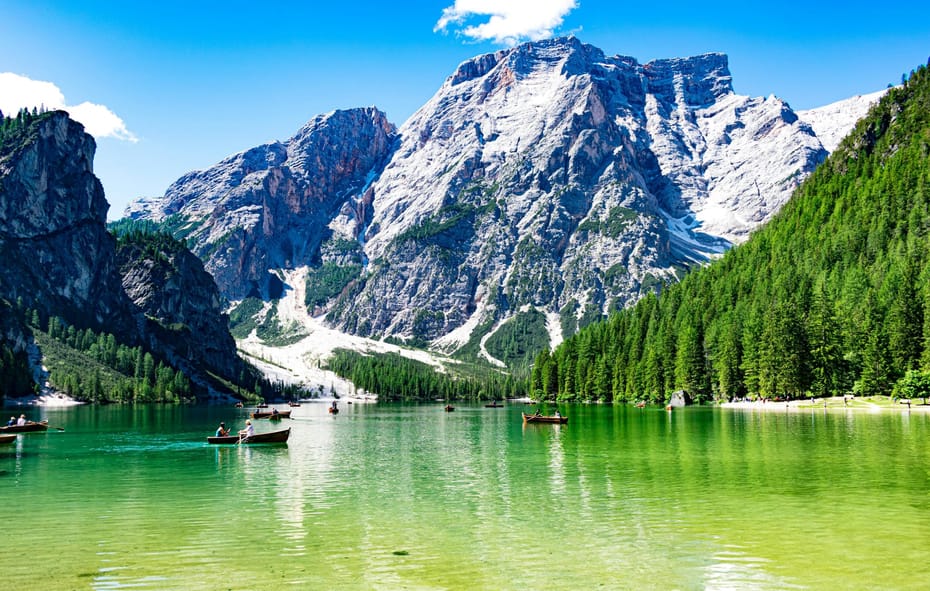
The Dolomites are a serious summer destination that most international visitors haven't considered. The hiking infrastructure is extensive, the scenery is at its most vivid in July when the meadows are in full colour, and the alpine lakes — Lago di Carezza, Lago di Braies, Misurina — are among the most beautiful in Europe.
The food deserves equal billing with the landscape. South Tyrolean cuisine is a genuine regional tradition — canederli, speck, Wiener Schnitzel alongside northern Italian pasta — served with wines from the nearby Alto Adige wine region, one of Italy's finest and least-known internationally. The combination of excellent skiing, extraordinary scenery, and serious food at a standard that French and Swiss Alpine destinations consistently fail to match is the Dolomites' strongest card.
Venice Marco Polo (VCE) is 2.5 hours from Cortina by road — the most common international gateway. Innsbruck (INN) in Austria is 2 hours and serves the northern Dolomites including Alta Badia and Val Gardena more directly. A private transfer from Venice Airport directly to Cortina is the most seamless arrival for ski groups — fixed rate, no luggage handling at commercial connections, door to door with ski equipment.
For groups flying from the US, Middle East, or elsewhere, a private charter into Venice with JetLuxe eliminates the commercial terminal experience entirely. For ski equipment on a charter, there are no hold restrictions and no carousel delays — the transfer to Cortina begins immediately on landing.
The journey passes through Italy and Austria, with roaming zones changing across the route. An Airalo European eSIM covers both countries on a single plan and activates before departure — useful for coordinating transfers and lodge check-ins across the border.
Venice Airport to Cortina — private transfer for ski groups
Book a private transfer →Charter to Venice — arrive ready for the mountain transfer
Charter with JetLuxe →The Dolomites are a UNESCO World Heritage Site — vertical limestone towers rising from green valleys with no equivalent in the French or Swiss Alps. The combination of this landscape with Italian culture, food, and hospitality creates an Alpine experience that differs meaningfully from Chamonix or Verbier. The South Tyrolean cuisine alone — blending Italian and Austrian traditions with wines from Alto Adige — makes the Dolomites worth visiting.
Yes — summer in Cortina offers hiking and cycling in extraordinary scenery, with alpine lakes, the Tre Cime circuit, and a slower, more Italian pace than ski season. The Mandarin Oriental Cristallo is positioning itself as a year-round mountain retreat. For non-skiers, summer is the more relaxed and arguably more beautiful season.
Only if the Olympics is specifically the reason for the trip. Cortina during the Games will be at maximum capacity with record prices. For skiing or the Mandarin Oriental, January before or March after the Games is significantly more enjoyable. If going for the Olympics, secure accommodation and tickets 12 months ahead.
The Dolomiti Superski pass connects 1,200km across 12 areas. Alta Badia is considered the finest terrain by serious skiers. Cortina is the most glamorous resort. The Sella Ronda circuit — a day-long tour around the Sella massif through four valleys — is the defining Dolomites experience, achievable by intermediate skiers.
Hotel information and event dates reflect published details as of April 2026. The Mandarin Oriental Cristallo opening schedule is subject to confirmation. This article contains affiliate links — bookings made through our links may earn a commission at no additional cost to you.
We use cookies to improve user experience. Choose what cookie categories you allow us to use. You can read more about our Cookie Policy by clicking on Cookie Policy below.
These cookies enable strictly necessary cookies for security, language support and verification of identity. These cookies can’t be disabled.
These cookies collect data to remember choices users make to improve and give a better user experience. Disabling can cause some parts of the site to not work properly.
These cookies help us to understand how visitors interact with our website, help us measure and analyze traffic to improve our service.
These cookies help us to better deliver marketing content and customized ads.