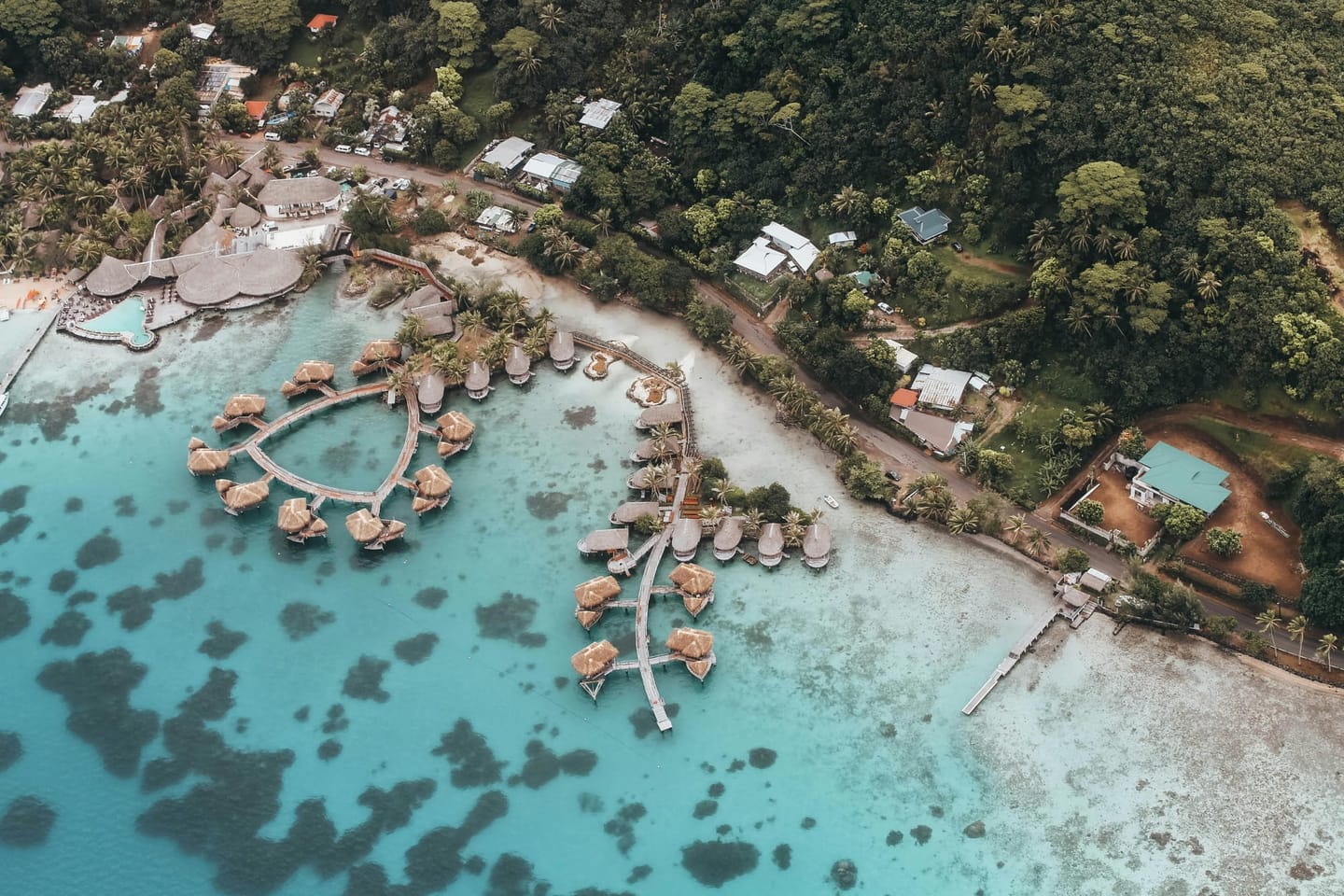
French Polynesia is the Pacific at its most extreme — colours that don't exist in Europe, marine encounters that have no equivalent, and a remoteness that a private vessel makes properly accessible. A guide for those who want to do it properly.
By Richard J. · Last reviewed April 2026
This site earns commission when you book through our links. Our editorial positions are formed independently — operators are recommended because they merit it, not because of commercial relationships.
French Polynesia sits halfway between California and Australia in the South Pacific, covering an area of ocean nearly the size of Western Europe. Of its 118 islands and atolls, most are reachable only by air or sea. The colours are not a photographic exaggeration — the lagoons are genuinely that shade of jade and turquoise, a consequence of specific water chemistry, coral depth, and the quality of Pacific light. A yacht charter here is not an upgrade on a resort holiday. It is the only way to reach the uninhabited motus, to anchor away from tourist infrastructure, and to combine the Society Islands' volcanic drama with the Tuamotus' extraordinary diving in a single continuous voyage.
Papeete is 8 hours from the US West Coast and 18 from Europe. For a charter that costs this much, arriving rested matters. JetLuxe operates Pacific routes including Los Angeles–Papeete, and connections from major European hubs via the Gulf or US.
Request a Charter Flight — JetLuxeFrench Polynesia's charter territory divides clearly between two geological and experiential worlds. Understanding the difference is the first planning decision.
The Society Islands are high volcanic islands — jagged peaks rising thousands of metres from the sea, draped in tropical forest, surrounded by barrier reefs that create vast shallow lagoons of the colour that made these islands famous. Bora Bora's Mount Otemanu, rising 727 metres from the lagoon, is the most photographed peak in the Pacific. The lagoon below it is the most photographed water. Both are better in person.
The charter experience in the Society Islands is built around the lagoon: anchoring in the shallows near a motu, snorkelling with lemon sharks and rays in water so clear you can see the coral in eight metres from the deck, tendering to a deserted sandbar for breakfast, watching the sun drop behind Otemanu from a cockpit position that no overwater bungalow can replicate.
Moorea is the underrated Society Island — closer to Tahiti than Bora Bora but with near-vertical mountains, the extraordinary Cook's Bay and Opunohu Bay (twin fjord-like inlets penetrating deep into the island's interior), and manta ray and lemon shark snorkelling consistently cited as among the finest in the Pacific.
Raiatea is the spiritual heart of Polynesia: Taputapuātea marae, on the island's southeastern coast, is where the great Polynesian navigators are believed to have departed on the voyages that populated Hawaii, New Zealand, and Easter Island. UNESCO World Heritage-listed, accessible directly from the water, and largely unvisited compared to the overwater bungalow resorts nearby. Taha'a, adjacent to Raiatea sharing the same barrier reef, is the vanilla island — the scent reaches the boat before the anchor is down.
The Tuamotus are the antithesis of the Society Islands. Where those islands rise dramatically from the sea, the Tuamotus barely clear it — flat rings of coral reef enclosing vast lagoons, the highest point rarely more than three metres above sea level. The experience they offer is entirely different: not volcanic drama, but oceanic immensity.
The passes — the channels cut through the reef connecting the open ocean to the lagoon — are what defines the Tuamotus for serious travellers. Twice daily, as the tides shift, the ocean forces through these narrow passages with enormous current. The marine life that rides these currents is extraordinary: at Fakarava's South Pass, hundreds of grey sharks gather to feed, along with clouds of grouper and parrotfish, manta rays gliding through the rush. Drift diving through a Tuamotu pass is one of the most significant marine encounters available anywhere on earth.
Beyond the diving, the Tuamotus offer isolation that the Society Islands cannot match. An uninhabited motu — a strip of white sand and coconut palms on the lagoon's edge — anchored off with no other vessel in sight is a genuinely remote experience that the world's most expensive overwater bungalow cannot manufacture. This is what the charter vessel unlocks here more than anywhere else in French Polynesia.
A week in the Society Islands typically begins in Papeete (Tahiti) and works northwest through the island chain, finishing at Bora Bora — or in reverse on a one-way charter repositioning the boat. The distances between islands are manageable under sail, the trade winds are consistent from the southeast, and each island offers a genuinely different character despite sitting within the same reef-rimmed geographical family.
Tahiti itself is often bypassed by charterers in favour of the outer islands, but Papeete's market (Le Marché) — tropical fruit, flowers, vanilla, black pearls, and the particular atmosphere of a French Pacific city — repays a morning ashore. Stock the galley from Le Marché; have the first dinner ashore; sail northwest in the morning.
The Tuamotus require a separate charter or a flight from Papeete to begin — the atolls are 300 to 500 kilometres from the Society Islands, too far to combine comfortably in a single week without sacrificing depth at both ends. A two-week charter that spends the first week in the Society Islands and repositions by air to the Tuamotus for the second is the standard approach, with the catamaran meeting you in Rangiroa.
Ten days minimum is the honest recommendation for the Tuamotus. Fakarava and Rangiroa are 80 miles apart — a full day's sailing each way — and doing both properly, plus Tikehau, requires time that a seven-day charter cannot provide without rushing every stop.
The Tuamotus' most celebrated diving destination. Fakarava's South Pass (Tumakohua) is where hundreds of grey sharks gather in the current — one of the great marine spectacles on the planet. The north pass (Garuae) is the widest navigable pass in Polynesia, with exceptional drift diving. Almost no tourist infrastructure outside two tiny villages.
The practical base for most Tuamotu charters: direct flights from Papeete and a lagoon so vast it takes several days to navigate meaningfully. Tiputa Pass offers the most accessible drift dive — dolphins, grey sharks, lemon sharks, occasional hammerheads. The Blue Lagoon, an extraordinary pool of luminous water within the main lagoon, is accessible only by tender.
Smaller and quieter than Rangiroa. Famous for pink and white sand beaches that turn the surrounding water an extraordinary shade, and fish biomass so high that studies have recorded more species density here than anywhere else in Polynesia. An easy day's sail from Rangiroa. The manta ray feeding aggregations in the pass are among the most consistent in French Polynesia.
The atoll that local captains recommend to guests who want what the Tuamotus used to be before Fakarava became known. Two permanent inhabitants. A pass with pristine coral and excellent diving. An anchorage in total solitude. The kind of place that, once anchored, makes any conversation about where else to go feel beside the point.
The geological anomaly of the Tuamotus: not a flat atoll but a raised coral island with cliffs up to 80 metres high, jungle-covered plateaux, and sea caves accessible only by boat. Once a major phosphate mining island, now almost entirely abandoned. Sea caves, sinkholes, coconut crabs, and silence.
A specific site within Tikehau's lagoon where manta rays consistently gather to feed and be cleaned. An in-water encounter with mantas — which can span three metres from wing to wing and move with implausible grace — is one of the defining experiences of any French Polynesia charter.
The outer Tuamotu atolls — Toau, Makatea, the western group — are some of the most remote places a private charter can reach. Medical evacuation from these locations is measured in days. SafetyWing covers international travellers anywhere, including remote Pacific passages, with no fixed end date and no itinerary declaration required.
Travel Medical Cover — SafetyWingHumpback whales. From July to October, humpback whales migrate through the Society Islands to give birth and mate. In-water encounters with a licenced guide, or simply observed as a whale surfaces 50 metres off the stern, have no equivalent anywhere that doesn't require extreme cold or expedition logistics. A catamaran anchored in Moorea's Opunohu Bay in August is one of the finest whale-watching positions in the Pacific.
Shark dives. The Tuamotu passes host grey reef sharks in numbers that have no parallel outside the Indo-Pacific's most remote locations. Fakarava's South Pass at the right stage of tide is not a dive where you hope to see a shark — it is a dive where you enter water containing several hundred of them. For those comfortable in the water with marine life, it is one of the most affecting underwater experiences in the world.
Manta rays. Both Moorea and Tikehau have consistent manta encounters. In Moorea's lagoon, mantas come to shallow-water cleaning stations where small fish remove parasites — a slow, unhurried spectacle visible from the surface to snorkellers. A morning spent drifting above a manta ray in water of extraordinary clarity simply doesn't need superlatives.
Lemon sharks and rays, Bora Bora. Bora Bora's lagoon offers a different kind of encounter: regular, calm, and well-suited to guests who are not divers. The southern reef hosts both lemon sharks — larger, slower, and more tolerant of human proximity than grey reef sharks — and eagle rays in shallow water. Morning snorkel sessions here with a local guide are one of the most consistent marine highlights in the Society Islands.
French Polynesia is expensive. Provisioning costs are significantly higher than any other major charter destination because almost everything is imported to Papeete and then transshipped to the outer islands. Fuel in the Tuamotus costs more than in Tahiti, which already costs more than Europe or the Caribbean. APA budgets here run higher than equivalent-looking charters elsewhere.
What that cost delivers is access to a part of the world that genuinely has no equivalent. The overwater bungalow at the Four Seasons Bora Bora is an excellent hotel. It looks at the lagoon. A catamaran is in it.
The charter fleet in French Polynesia is genuinely small — a handful of quality crewed catamarans competing for a global pool of serious guests. If you are planning a 2026 peak-season charter and are reading this in spring, start immediately. If you are planning for 2027, start in autumn. This is not a destination where the right vessel is available last-minute. The brokers who represent the best boats have waiting lists, not availability calendars.
Data roaming in French Polynesia is expensive — and connectivity matters when coordinating domestic flights, provisioning runs, and weather routing between atolls. Airalo's French Polynesia eSIM covers the whole territory on a single plan and activates before you fly.
Get a French Polynesia eSIM — AiraloPapeete (Faa'a International Airport) is the entry point for French Polynesia. Direct or one-stop connections operate from Los Angeles, San Francisco, Tokyo, Auckland, and Paris. From the US West Coast, the flight is approximately eight hours. Domestic Air Tahiti flights connect Papeete to Bora Bora (45 minutes), Moorea (10 minutes by prop), Raiatea, Huahine, Rangiroa, Fakarava, and Tikehau.
The catamaran is the vessel of choice here, as elsewhere in the Pacific, for specific practical reasons: the lagoons are shallow in places and require modest draft; the trade winds make sailing practical; and the broad beam creates the deck space that defines the onboard lifestyle. Motor yachts exist in the fleet but are rare — partly due to fuel costs at this distance from global bunkering infrastructure.
Provisioning is best done thoroughly in Papeete before departure. Le Marché for fresh produce; supermarkets for provisions; the fish market on the waterfront for the best local fish at prices that will not apply further out. The outer island villages have provisions but limited selection. The crew will know all of this; trust their local knowledge and give the provisioning run proper time.
If the private charter fleet's pricing or booking lead times don't fit your circumstances, French Polynesia's small-ship expedition sailings — which cover the same atolls and Society Islands on a shared-vessel basis — are the closest available alternative. CruiseDirect lists sailings across the Pacific including French Polynesia itineraries.
Explore French Polynesia Sailings — CruiseDirectFlying from Los Angeles, San Francisco, or Europe to Papeete for your charter? JetLuxe makes the 8-hour Pacific crossing worth starting well.
Charter a Flight — JetLuxeWe use cookies to improve user experience. Choose what cookie categories you allow us to use. You can read more about our Cookie Policy by clicking on Cookie Policy below.
These cookies enable strictly necessary cookies for security, language support and verification of identity. These cookies can’t be disabled.
These cookies collect data to remember choices users make to improve and give a better user experience. Disabling can cause some parts of the site to not work properly.
These cookies help us to understand how visitors interact with our website, help us measure and analyze traffic to improve our service.
These cookies help us to better deliver marketing content and customized ads.