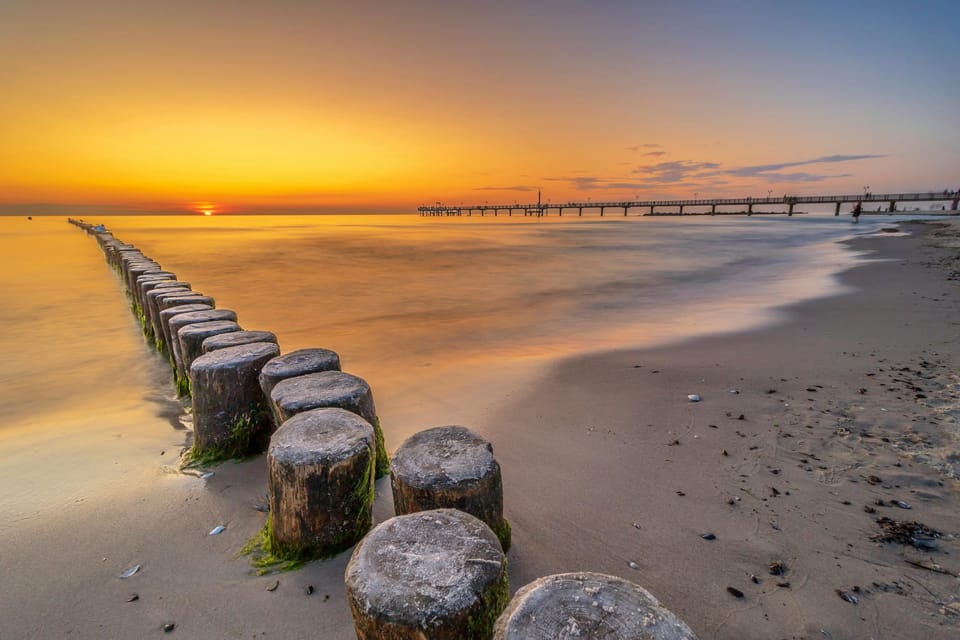
The most culturally dense sailing ground in Europe. Hanseatic cities, medieval capitals, chalk cliffs, amber beaches, and the ghost of the Iron Curtain.
By Richard J. · Last reviewed April 2026
This site earns commission when you book through our links. Our editorial positions are formed independently — operators are recommended because they merit it, not because of commercial relationships.
The Baltic is not a single destination. It is an inland sea the size of Spain, bordered by nine countries, with 8,000 kilometres of coastline ranging from the white chalk cliffs of Rügen to the medieval ramparts of Tallinn to the amber beaches of the Polish coast. No other sailing ground in Europe puts this many UNESCO World Heritage cities within a week's sailing range of each other. No other sailing ground carries this much history this close to the water. What the Baltic lacks is the warmth and predictability of the Mediterranean. What it offers instead is something rarer: a coherent sailing narrative through the heartland of European civilisation, with a sequence of landfalls that change character completely every two days.
Hamburg, Kiel, Tallinn, Riga, Gdańsk, and Copenhagen are all served by private charter. A Baltic itinerary covering multiple countries in a short season rewards a clean, direct arrival — no missed connections, no checked luggage, no rebooking risk. JetLuxe covers all six cities.
Request a Charter Flight — JetLuxeThe Baltic is best understood not as a single charter destination but as four overlapping sailing regions, each with its own character, its own level of difficulty, and its own reason to sail there. Most charterers focus on one or two of these regions in a week — the geography is too large to cover in its entirety without a passage-making trip of several weeks.
The German Baltic coast runs from Flensburg on the Danish border east to Rügen, with the Kiel Fjord at its centre. This is the most developed charter market in the Baltic: multiple bases (Kiel, Flensburg, Rostock, Warnemünde, Stralsund), a large and modern fleet, well-equipped marinas at comfortable distances from each other, and sheltered waters suited to mixed-experience crews.
Lübeck is the greatest Hanseatic city in Germany and one of the finest medieval towns in Northern Europe — Thomas Mann territory, with its brick-Gothic architecture and the Holstentor gateway visible from the water. Stralsund, opposite Rügen, is UNESCO World Heritage-listed for its own magnificent Hanseatic townscape. Rügen itself — Germany's largest island — has 547 kilometres of coastline, chalk cliffs at Jasmund National Park that Caspar David Friedrich painted in the 19th century, and the distinctive imperial-era seaside resorts at Binz and Sellin.
The Bodden — the complex lagoon system behind Rügen's western coast, where fresh water mixes with the Baltic in shallow reed-fringed channels — is one of the most atmospheric inland waterways in Germany. Slow sailing through the Bodden at low tide, with the steeple of Stralsund visible above the reeds and egrets standing in the shallows, is the Baltic at its most contemplative.
Estonia is the Baltic States' most developed charter destination. Tallinn's Old Town — one of the most completely preserved medieval cities in Europe and UNESCO World Heritage-listed — is accessible directly from the water, with Pirita Marina a short taxi ride from the towers and cobblestones. The contrast between the grey Soviet-era apartment blocks visible from the marina approach and the red-roofed medieval centre is one of the most striking in European sailing.
The Estonian islands — Saaremaa, Hiiumaa, Vormsi, and the numerous smaller islands of the West Estonian Archipelago (a UNESCO Biosphere Reserve) — are the sailing ground that rewards the effort of getting there. The archipelago is demanding: complex pilotage among hundreds of islands, some poorly marked. The reward is extraordinary solitude. Many outer islands are uninhabited; some retain traces of pre-modern culture that predates the Soviet period entirely.
Latvia's capital Riga is a worthwhile detour: Art Nouveau architecture on a scale found nowhere else in Europe (over 800 buildings), a historic centre with UNESCO status, and a marina on the Daugava River within walking distance of the old city. Lithuania's coastline includes the Curonian Spit — a UNESCO-listed sand dune peninsula separating the Baltic from the Curonian Lagoon.
Poland's 500-kilometre Baltic coast is an underrated charter ground and the cheapest in the region. The coast is dominated by long stretches of white sand and pine forest, punctuated by modern marinas that have developed rapidly over the past two decades. The sailing is different from elsewhere in the Baltic: fewer sheltered stops, longer coastal passages, and conditions that can deteriorate quickly when northerly systems arrive. This is not beginner sailing.
The destination that justifies the effort is Gdańsk. One of the great port cities of European history — the birthplace of the Solidarity movement, the Free City of Danzig of the interwar period, a Hanseatic trading capital for five centuries before that — Gdańsk has a marina in the city centre. The colourful merchant houses along Długie Pobrzeże, rebuilt stone by stone after wartime destruction, line the canal directly from the water. The shipyard where Solidarity was born is a ten-minute walk from the marina.
The Polish coast also offers one of the Baltic's more unusual experiences: beachcombing for amber after a northerly blow. The Baltic holds the world's largest amber deposit and storms regularly wash pieces ashore along the Polish and Lithuanian beaches, particularly around Usedom and the Curonian Spit.
Bornholm is the geographic and cultural crossroads of the Baltic: a Danish island lying closer to Sweden and Poland than to the Danish mainland. Round churches (built as both places of worship and fortresses), the medieval Hammershus (the largest castle ruin in Northern Europe), traditional smokehouses producing the island's signature herring, and an arts community that has made Bornholm the Baltic equivalent of Nantucket. A natural waypoint between Germany and the Baltic States.
Gotland, the large Swedish island in the central Baltic, is the region's other great waypoint. Visby — a medieval walled city with 44 church ruins within the walls and the most complete medieval ring wall in Scandinavia — is UNESCO World Heritage-listed and one of the most atmospheric harbour arrivals in the entire Baltic. The island's medieval week in August draws visitors from across Europe; advance booking is essential. The rest of the summer, Gotland is quieter: raukar (distinctive limestone sea stacks), lavender fields, and the particular Baltic light that turns amber and horizontal in the evening.
The Baltic's defining quality is the sequence of cities it puts within sailing range. No other charter ground in Europe delivers cultural stops of this density and quality within passages of this length. A two-week Baltic charter can visit five or six cities each of which would anchor a proper land-based trip.
The Queen of the Hanseatic League. The Holstentor gate is one of the most reproduced images in German architecture. The Marienkirche's twin towers, the merchant houses of the Breite Strasse, the marzipan tradition (Niederegger has been here since 1806), and the Thomas Mann house are all within walking distance of the marina. One of the great port cities of medieval Europe, still largely intact.
Rügen's gateway city. The brick-Gothic St. Mary's Church and the Ozeaneum (one of Germany's finest natural history museums, dedicated to the sea) anchor a townscape with UNESCO World Heritage status for its Hanseatic architecture. The crossing from Rügen to Stralsund through the Strelasund strait is one of the most atmospheric approaches in the German Baltic.
The most completely preserved medieval city in Northern Europe. The Old Town's limestone towers, merchant warehouses, Toompea Castle on the upper hill, and the Estonian History Museum inside a medieval merchant's house are all within the walled perimeter. The contrast with the Soviet-era periphery visible from the marina makes Tallinn one of the most visually distinctive arrivals in the Baltic.
The largest city in the Baltic States, with over 800 Art Nouveau buildings — a concentration unmatched anywhere in the world. The Old Town is UNESCO-listed; the Central Market (housed in former Zeppelin hangars) is the largest market in Europe by footprint. Gothic spires, cobblestone streets, and a food scene that has developed rapidly in the past decade.
Where the Second World War effectively began (the bombardment of the Westerplatte, September 1939) and where the Soviet system began its collapse (the Gdańsk Shipyard strikes, 1980). The European Solidarity Centre is one of the finest political museums in Europe. The Long Waterfront is magnificent. The amber market is the best on the coast.
The westernmost major Baltic stop and the finest city on the sea. Nyhavn's colourful 17th-century harbour is directly accessible by water. The restaurant scene is among the finest in Europe. Most Baltic charterers use Copenhagen as either a start or end point, building the rest of the itinerary around it.
The Kiel Canal (Nord-Ostsee-Kanal) is 53 nautical miles of managed waterway cutting through Schleswig-Holstein and connecting the North Sea at Brunsbüttel with the Baltic at Kiel. For boats approaching the Baltic from British or Dutch waters, it is the standard entry point — avoiding the long passage around the tip of Denmark through the Skagerrak and Kattegat.
The transit is straightforward but requires attention. The canal carries significant commercial shipping traffic; yachts must keep well to starboard and follow light signals. Most yachts motor through rather than sail; the canal is too narrow for comfortable sailing in most conditions. The transit takes five to seven hours at normal yacht speeds, with the option to moor overnight at Rendsburg at the canal's midpoint — worth doing if time allows, as the Rendsburg High Bridge is a remarkable piece of engineering visible from the water.
The alternative is sailing around the northern tip of Denmark through the Skagerrak and Kattegat — a longer passage with more open-water exposure but spectacular scenery at Skagen where the two seas visibly meet. For boats with sufficient time and an experienced crew, the northern route is more interesting sailing; for boats on a tight schedule, the canal is the practical choice.
A Baltic itinerary covering Germany, Estonia, Latvia, and Poland means transfers at multiple airports — Kiel/Hamburg, Tallinn, Riga, Gdańsk. Pre-booking private transfers through GetTransfer means a fixed price and a confirmed driver at each arrival, with no airport taxi negotiations in a language you don't speak.
Book Marina Transfers — GetTransferThe Baltic is among the most affordable charter markets in Europe — significantly cheaper than the Mediterranean equivalent, and cheaper than Norway or Sweden's western sailing grounds. The tradeoff is a shorter season, a less glamorous fleet profile on average, and weather that requires more active monitoring. For the right crew, it is outstanding value: a week sailing from Kiel through the German islands to Bornholm and back covers sailing ground that most European charterers have never seen, at a cost well below a comparable Greek or Croatian charter.
A Baltic charter crossing Germany, Estonia, Latvia, and Poland can involve three or four flights in a single trip — and Baltic weather means delays run higher than southern European routes. AirHelp claims flight compensation for qualifying disruptions across all these routes, at no upfront cost.
Protect Your Baltic Flights — AirHelpThe Baltic does not offer warm water swimming in the Mediterranean sense. Even in peak July, water temperatures in the open Baltic run 17–20°C — refreshing rather than warm, and cold enough to make extended swimming uncomfortable without a wetsuit in all but the most sheltered bays. The western Baltic's shallow, sheltered areas (Bodden lagoons, inner Danish islands) warm faster and are more suitable for swimming.
The Baltic is not a reliable anchorage destination in the Mediterranean sense either. The tidal range is small (mostly under 30cm) but winds can shift quickly and many anchorages that are comfortable in westerlies become exposed when the wind backs north or east. The region has abundant marinas — a legacy of its strong domestic sailing culture in Germany and Scandinavia — and most Baltic charterers use marinas rather than anchorages as their primary overnight option.
What the Baltic does offer, consistently and unreservedly, is the sense of sailing through living history. The Hanseatic network that built Lübeck, Stralsund, Tallinn, and Riga was the economic foundation of medieval Northern Europe, and its architecture is still standing. The amber trade that predates recorded history still washes up on the beach after a storm. Gdańsk's shipyard, where a labour movement began that would eventually bring down the Soviet Union, is visible from the water. The Baltic is where the big stories of European history are still attached to physical places — and a yacht is the right vehicle for making that connection.
A Baltic charter crossing Germany, Estonia, Latvia, and Poland covers five different health care jurisdictions. The remote outer islands of the West Estonian Archipelago are among the most isolated sailing destinations in Europe. SafetyWing covers international travellers anywhere in these waters, on a flexible rolling basis with no fixed end date.
Travel Medical Cover — SafetyWingFlying to Kiel, Hamburg, Tallinn, Riga, or Gdańsk for your Baltic charter? JetLuxe covers all five cities with same-day availability.
Charter a Flight — JetLuxeWe use cookies to improve user experience. Choose what cookie categories you allow us to use. You can read more about our Cookie Policy by clicking on Cookie Policy below.
These cookies enable strictly necessary cookies for security, language support and verification of identity. These cookies can’t be disabled.
These cookies collect data to remember choices users make to improve and give a better user experience. Disabling can cause some parts of the site to not work properly.
These cookies help us to understand how visitors interact with our website, help us measure and analyze traffic to improve our service.
These cookies help us to better deliver marketing content and customized ads.