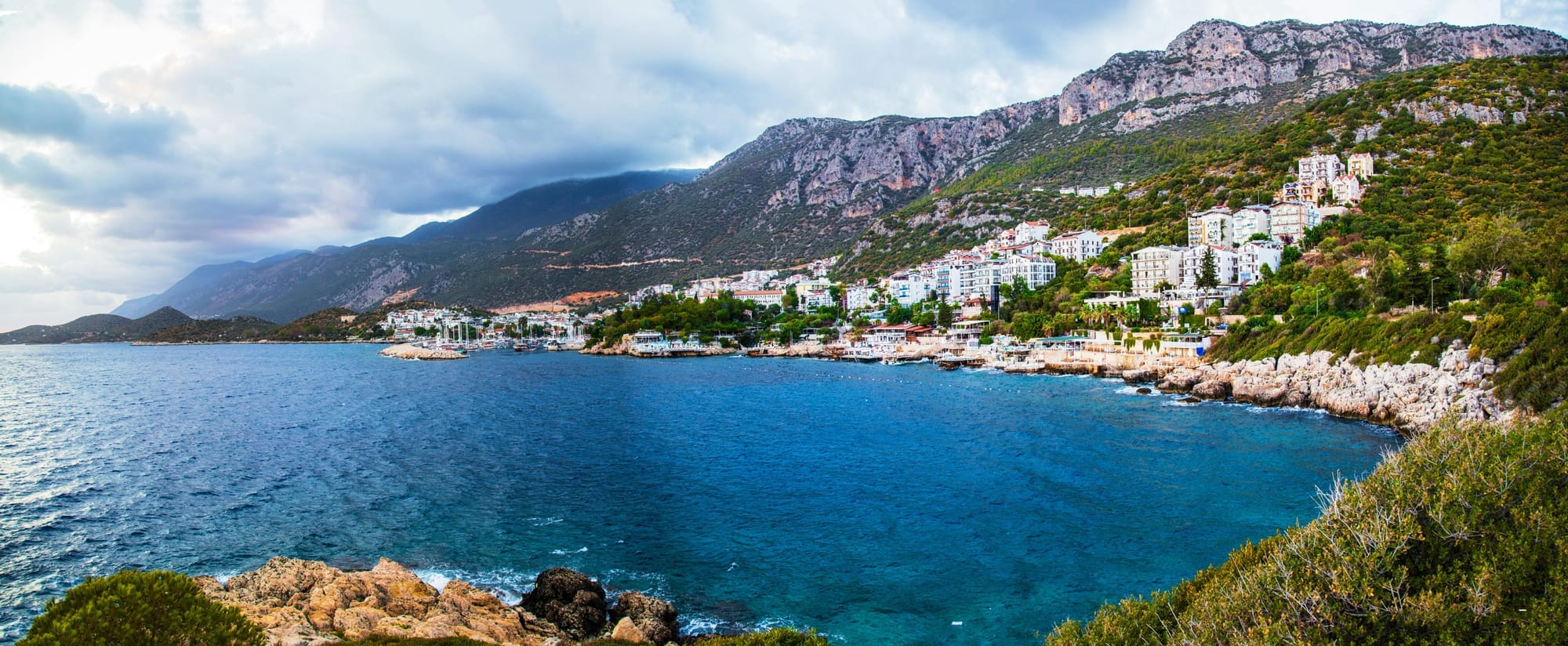
Three thousand years of civilisation within swimming distance. A culinary tradition built into the charter itself. A vessel architecturally suited to this coast in a way no modern production yacht can match. A guide for those who want the real thing.
By Richard J. · Last reviewed April 2026
This site earns commission when you book through our links. Our editorial positions are formed independently — operators are recommended because they merit it, not because of commercial relationships.
The Turkish gulet charter is one of the great underrated experiences in private travel. Not underrated in the sense of undiscovered — people have been sailing this coast for a century — but underrated in the sense that most people who haven't done it don't fully understand what it delivers. The Turquoise Coast earned its name. The particular shade — somewhere between jade and aquamarine, shifting with depth and light — is a consequence of limestone geology and specific water chemistry. You anchor in it, swim through it, and watch ancient Lycian ruins through it from the deck. There is nowhere else in the Mediterranean that offers this combination.
A gulet is not a compromise between a sailing yacht and a motor vessel. It is a purpose-built vessel for a specific way of travelling a specific coastline — and it has been refined over several generations of Turkish boat builders, primarily in the yards of Bodrum and Bozburun, to do exactly this job better than anything else.
The hull form is wide and shallow-drafted, allowing access to coves and anchorages that deeper-keeled sailing yachts cannot reach. The broad beam creates deck space that is genuinely social — a gulet's aft deck, shaded by a canvas awning and spread with cushions, is where the charter lives: meals served here, afternoons spent here, evenings here with the mountains on one shore and the pine forest on the other. The saloon below is large enough for proper dining and proper conversation. The cabins are ensuite and air-conditioned; on the best vessels they are finished to a hotel standard that surprises guests who arrive expecting a boat.
The crew — typically four or five people on a luxury gulet — is the other defining element. The captain navigates and manages the vessel. The chef sources fresh produce at each port and prepares three meals a day from scratch: meze breakfasts, fresh fish lunches, grilled meats and seafood in the evening. The hostess manages the cabin service and guest experience. This is the level of staffing that makes a gulet charter feel more like a private villa than a boat holiday — except that the villa moves to a different extraordinary location every morning.
The choice of base determines the character of the week. Each departure point opens a different section of the coast, and the best Turkish gulet captains know their local waters intimately in a way that makes this decision significant.
Göcek is 20 minutes from Dalaman Airport and positioned at the heart of the Gulf of Fethiye, which the 12 Islands protect from open-sea swell. The water inside the gulf is famously calm — described by captains as lake-like — which makes it the most relaxed sailing environment on the Turquoise Coast and ideal for those who are not experienced sailors or who are travelling with children. The town itself is small, elegant, and yacht-orientated without being brash: good restaurants on the waterfront, excellent provisioning, and a notable absence of the resort-hotel atmosphere that characterises larger ports.
From Göcek, the itinerary options run in both directions. West toward Marmaris and the Gulf of Hisarönü passes through some of the most secluded anchorages on the coast. East toward Fethiye and the Lycian coastline opens the archaeology-rich route toward Kekova. The Göcek-based charter is the most flexible on the coast, and the most consistently recommended by experienced gulet brokers for first-time Turkey visitors who want quality above everything else.
Bodrum was ancient Halicarnassus — birthplace of Herodotus, site of the Mausoleum of Halicarnassus (one of the Seven Wonders of the Ancient World). The 15th-century Crusader castle houses the Museum of Underwater Archaeology, one of the finest maritime museums in the world, displaying ancient shipwrecks raised from the seabed off the Turkish coast, including a Bronze Age wreck from 1300 BC — the oldest known seafaring vessel. Plan a full morning ashore.
Bodrum is also the liveliest town on the Turquoise Coast: boutiques, excellent restaurants, nightlife, a harbour with the castle illuminated in the evenings and the gulet fleet moored along the quay. The Gulf of Gökova to the east is one of the finest sailing grounds in Turkey: pine-covered mountains descending to the shore, and a sequence of anchorages including Kara Ada (with hot mineral spring pools), Cleopatra Island, and the ruins of Knidos at the tip of the Datça Peninsula — where the Aegean and the Mediterranean meet.
Marmaris is a larger, busier town than Göcek or Bodrum — significant resort infrastructure, excellent marina facilities, and a lively waterfront. Its value as a charter base is less the town itself than the sailing ground it unlocks. The Gulf of Hisarönü stretches 30 nautical miles southwest into the Aegean, with the Greek islands of Kos and Rhodes visible on one side and the Turkish mainland on the other. The anchorages at Selimiye, Bozburun, and Orhaniye are among the most charming on the coast.
Bozburun deserves particular mention. This is where gulets are still built — a small village with a harbour lined with workshops, the smell of cut wood and varnish, half-finished wooden hulls propped in the yards. Watching craftsmen build the boats you are sailing on, in the same village where the tradition began, is one of those moments of authentic connection that no resort can manufacture. The route from Marmaris west eventually puts Rhodes on the horizon; crossing over for a day or two with the right customs clearance paperwork is one of the coast's great itinerary additions.
Fethiye is the gateway to the Lycian coast — the most archaeologically dense section of the Turkish Riviera. The Lycians left behind a funerary architecture unlike anything else in the ancient world: rock-cut tombs carved directly into cliff faces, sarcophagi raised on high pedestals in the middle of modern towns, temple-form tombs with elaborate friezes. In Fethiye itself, the cliff above the town is honeycomb with Lycian rock tombs. In Kaş, a Lycian sarcophagus sits in the middle of a traffic roundabout, surrounded by bougainvillea.
The route east from Fethiye toward Kekova is the most historically rich single week's sailing on the Turkish coast. Gemiler Island has Byzantine monastery ruins visible from the water. Kaş is one of the most charming small towns on the coast — boutique shops, good diving, Lycian tombs in the main street. And Kekova is unlike anywhere else in the Mediterranean: a sunken Lycian city, partially submerged by ancient earthquakes, its walls and staircases visible through water of extraordinary clarity. This is a designated protected zone — no swimming, no diving — but sailing slowly above the ruins and seeing rooms and doorways beneath the surface is one of the most quietly remarkable experiences in Mediterranean travel.
The Turquoise Coast carries the densest concentration of ancient sites accessible by water in the Mediterranean. The Lycian civilisation, the Greeks, the Romans, the Byzantines, and the Ottomans all built on this coast, and the traces are everywhere — often in settings that no road reaches. The gulet is not just transport; it is access.
The Mausoleum of Halicarnassus was one of the Seven Wonders of the Ancient World. The castle's Museum of Underwater Archaeology is one of the finest maritime collections in the world, including a Bronze Age shipwreck from 1300 BC. Plan a full morning ashore.
A major Dorian city built at the very tip of the Datça Peninsula, where the Aegean meets the Mediterranean. The site straddles the point, with one harbour on each sea. Famous in antiquity for the first known naked statue of Aphrodite, now lost. Accessible only by sea or a very long road. Most gulets anchor here for lunch.
Ancient Antiphellos sits beneath modern Kaş. Rock-cut Lycian tombs are carved into the cliffs above the town and a freestanding sarcophagus stands in the main street. A small Hellenistic theatre overlooks the sea, a five-minute walk from the marina. One of the coast's most atmospheric harbours, with excellent diving in the surrounding bays.
A Lycian settlement partially submerged by earthquakes in the 2nd century AD. Walls, staircases, doorways, and pathways are visible through extraordinary clear water. No swimming or diving permitted in the protected zone, but sailing slowly above the ruins is one of the Mediterranean's most arresting experiences. The adjacent village of Kaleköy sits below Simena Castle with panoramic views over the bay.
Ancient Kaunos is reached by anchoring at Ekincik Bay and taking a river boat through the reeds of the Dalyan Delta. Rock-cut Lycian tombs carved in the cliff face above the river are visible from the water as you approach — some of the finest examples on the coast. The delta is a loggerhead sea turtle nesting ground; the beach at Dalyan is protected accordingly.
Sedir Island in the Gulf of Gökova has a beach with sand so fine and uniform that local tradition holds it was brought from Egypt by Cleopatra for Mark Antony. Whether or not the story is true, the beach is unique: the sand looks and feels different from any other on the coast, and the island's Hellenistic ruins and clear water make it a memorable stop regardless of the legend.
Turkish gulet cuisine is one of the most underrated culinary experiences in private charter travel. The chef — on a quality gulet, a genuine professional who takes the role seriously — shops at local markets at each port. Breakfast is a spread: fresh bread, white and aged cheeses, olives, tomatoes, cucumbers, honey, clotted cream, eggs cooked to order, fresh fruit, tea. Not assembled from pre-packaged components but prepared each morning with ingredients sourced hours earlier.
Lunch is typically a meze selection followed by a main — fresh fish caught locally, grilled simply, served with lemon and olive oil. The Turkish meze tradition is extensive: stuffed vine leaves made fresh, not from a jar; white bean salad with capers and parsley; grilled aubergine with yoghurt; lahmacun from a harbour bakery; köfte prepared aboard. Turkish cuisine at its best is simultaneously simple and precise, and a good gulet chef demonstrates this every meal.
Evening meals are the occasion. Fish grilled over charcoal with a view of a pine-covered bay. A whole sea bass bought from the fishing boat that pulled alongside in the afternoon. Grilled octopus with lemon and herbs at a quayside restaurant in Selimiye. Turkish wine — underrated by anyone who hasn't tried it seriously — from producers in Thrace and the Aegean that have developed significantly in the past decade. The food on a Turkish gulet charter is not a supporting detail; it is a primary experience.
The quality range in the Turkish gulet market is wide, and photographs do not tell the whole story. A gulet that looks elegant in the brochure may have a captain who does the same three anchorages every week and a chef who opens cans. The factors that actually determine the quality of the experience are not always visible in the specification sheet.
The chef is the single most important variable. A chef who shops at the market each morning, who takes genuine pride in the meze they assemble and the fish they grill, who engages with guests' dietary preferences and adjusts accordingly — this person makes the charter. A chef who follows a fixed menu and resents the work makes the charter something to endure. Ask your broker to describe the chef specifically. If they cannot, they do not know the boat well enough.
The captain's knowledge of anchorages is the second variable. The popular coves on every route — the ones listed in every charter guide — are crowded in July and August. A captain who knows the secondary anchorages, the bays that fit six boats rather than sixty, the coves accessible only to vessels of a specific draft at certain states of wind — this knowledge is what separates a gulet charter from a charter itinerary.
The third variable is maintenance. Wooden vessels require continuous, serious maintenance. A well-maintained gulet has paint and varnish in good condition, deck hardware that works properly, mechanical systems that function reliably, and cabins that are genuinely clean rather than superficially so. Ask for the date of the most recent survey and refit.
The Turkish gulet market has many operators who list vessels they have never visited. A broker who can describe specific cabins, name the captain, give a personal account of the food quality, and tell you which anchorages the captain favours — this is who you want. Book through a broker with direct, recent knowledge of the specific vessel you are considering. The best gulets in the Turkish market are booked 6–12 months ahead for peak season. Starting the conversation in spring for a summer charter means working with whatever is left.
Turkish gulet charters are typically full-board all-inclusive: three meals per day prepared aboard, fuel for the itinerary, port fees, and crew included in the base rate. Drinks are usually an additional package or settled separately. Shore excursion entry fees are not included. The overall cost structure is considerably more transparent than a Mediterranean plus-expenses charter, and the value at the luxury level is genuine: the standard of food, crew, and experience available at $25,000–$35,000 per week on a Turkish gulet is difficult to match anywhere else in the Mediterranean at the same price point.
One of the Turquoise Coast's less-discussed advantages is its proximity to the Greek islands. From Bodrum, Kos is visible on a clear day. From Marmaris and the Gulf of Hisarönü, Rhodes is 40 nautical miles away. Symi, one of the most beautiful small Greek islands in the Dodecanese, sits between the two coasts like a natural waypoint.
A two-week charter that begins in Göcek, works west through the Gökova and Hisarönü gulfs to Bodrum, then crosses to Kos, hops to Symi and Rhodes, and returns to Marmaris covers two of the Mediterranean's finest sailing grounds in a single continuous voyage. The cultural contrast — Turkish fishing villages and Byzantine ruins on one shore, whitewashed Dodecanese architecture and Greek tavernas on the other — is one of the more compelling itinerary propositions in the Mediterranean. Turkish and Greek customs formalities apply at each crossing; your captain handles the process and your broker ensures the vessel is correctly licensed for both waters before departure.
Turkey sits outside EU health coverage zones. For guests travelling from multiple countries to join a charter, travel medical cover is worth arranging before departure — particularly for itineraries that cross between Turkish and Greek waters.
Travel Medical Cover — SafetyWingTravelling to Turkey from abroad? Cover your group before you depart — Turkey sits outside EU health zones.
Travel Cover — SafetyWingWe use cookies to improve user experience. Choose what cookie categories you allow us to use. You can read more about our Cookie Policy by clicking on Cookie Policy below.
These cookies enable strictly necessary cookies for security, language support and verification of identity. These cookies can’t be disabled.
These cookies collect data to remember choices users make to improve and give a better user experience. Disabling can cause some parts of the site to not work properly.
These cookies help us to understand how visitors interact with our website, help us measure and analyze traffic to improve our service.
These cookies help us to better deliver marketing content and customized ads.