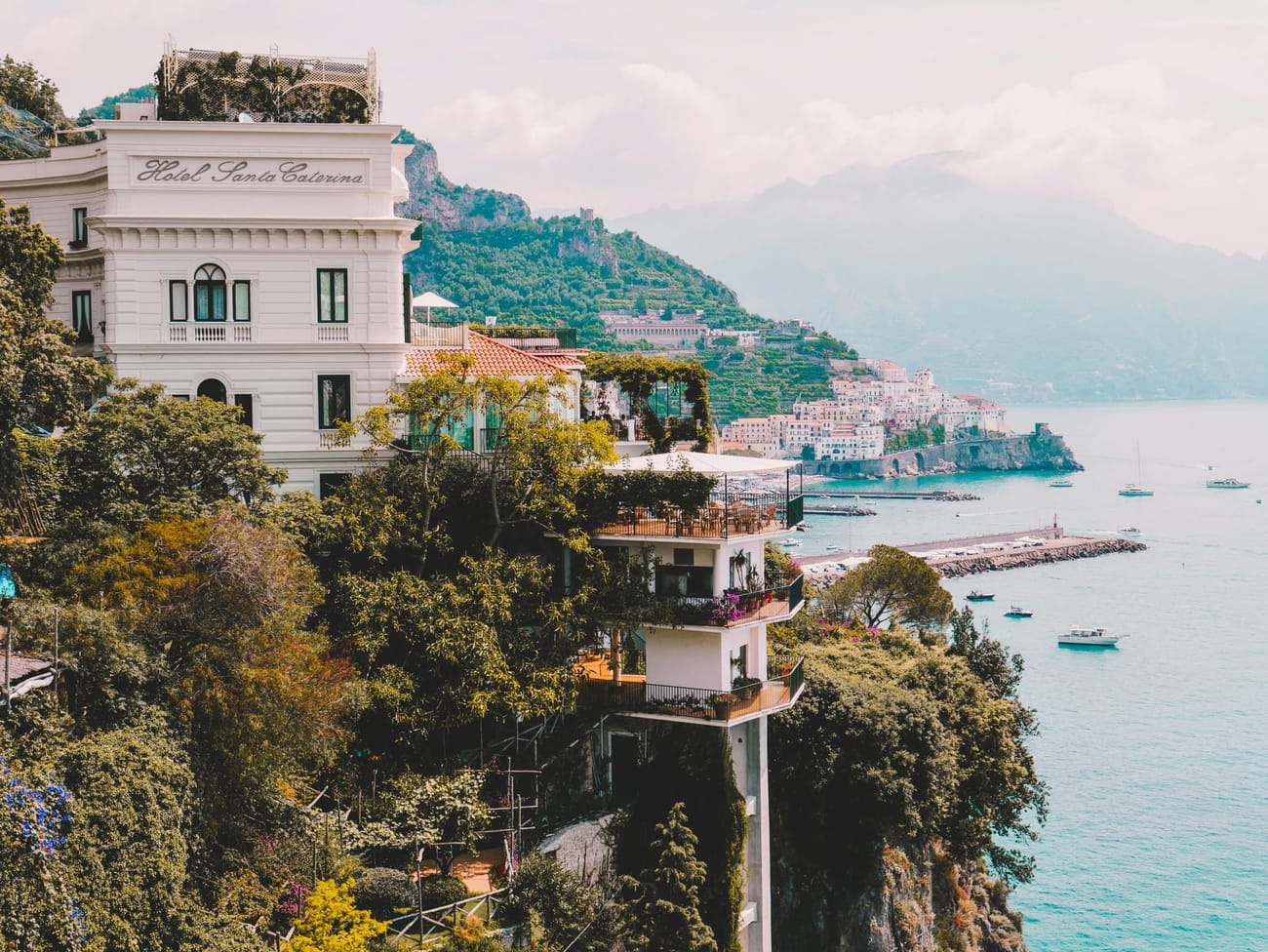
Italy is not a single charter destination — it is five distinct cruising grounds, each with its own character, anchorage profile, cuisine, and appropriate guest type. The Amalfi Coast is not Sardinia. Sicily is not Portofino. Choosing the right region is the decision that shapes everything else.
By Richard J. · Last reviewed April 2026
This site earns commission when you book through our links. Our editorial positions are formed independently — operators are recommended because they merit it, not because of commercial relationships.
Italy has 7,500 kilometres of coastline and more than 200 islands. The right region is the decision that shapes everything else — the social atmosphere, the anchorage style, the food, and the kind of guest who will find the week genuinely excellent rather than merely impressive.
The Amalfi Coast is the definition of the Italian coastal experience: pastel houses stacked against near-vertical limestone cliffs, lemon groves tumbling to the water, the smell of wood smoke and salt in the evening. Arriving by sea — the only angle from which the full scale of the coastline reveals itself — is the right way to do it. There are no roads wide enough to match the view from the water.
The practical reality of chartering here is that deep-water berthing is limited. The Amalfi Coast was built for fishing boats, not superyachts, and the infrastructure reflects that. Most large vessels anchor in the bay off each town and use the tender to go ashore. This is not a disadvantage — it is the only way to arrive at Positano with any dignity, watching the town from the water as the light changes on the cliff face. Naples and Salerno provide the main superyacht marina infrastructure for the region.
Positano is at its best from the water. The town cascades down a near-vertical slope in layers of terracotta, ochre, and cream, ending at a small harbour beach that is perpetually oversubscribed. The anchorage in the bay in front of the town is the right approach: anchor, pour a drink, and watch the city lights come on as the sun sets behind the cliff. Dining ashore means climbing stairs — the town has essentially no flat ground — and the restaurants perched on the rock face above the harbour are the most memorable. Regional dishes include spaghetti alle vongole with local olive oil, fried anchovies with mint and vinegar, and babà cake soaked in rum with wild strawberries.
Capri is visited by everyone and dismissed by no one who actually spends time there. The Blue Grotto — a sea cave where refracted light turns the water an intense electric blue — is a morning visit by rowing boat from the water. Marina Grande on the north coast accommodates yachts up to approximately 60 metres; the anchorage at Marina Piccola on the south coast, guarded by the Faraglioni rock stacks, is the more dramatic alternative. The town itself — a ten-minute funicular above the port — has designer boutiques and restaurants perched vertiginously above the Mediterranean. The ruins of Tiberius's palace at Villa Jovis are an hour's walk from the town centre.
Ischia is the largest island in the Bay of Naples and the least famous for the quality it delivers. The island is volcanic, with natural thermal springs accessible directly from the sea at Sorgeto Bay — hot volcanic water meeting the cold Tyrrhenian in a cove formed by the same geological activity that created the springs. The coastal village of Sant'Angelo is car-free and built on a natural rock promontory connected to the island by a narrow sand bar. For guests who find Capri too structured and Positano too photographed, Ischia represents what the Bay of Naples was before it became a destination.
When the Amalfi Coast marinas fill and Capri feels like a city, the Pontine Islands — two hours northwest across open water — offer something the famous destinations cannot: space. Ponza is the largest, with white limestone cliffs dropping into turquoise coves, a pastel harbour town hanging on a steep hillside, and a social life that operates on Italian island time rather than tourist agenda. Palmarola, uninhabited, has clear water and cave swimming of the kind that the more famous islands were built on before the yachts arrived.
Sardinia is where raw natural beauty and deliberate superyacht infrastructure converge more successfully than anywhere else in the Italian charter market. The Costa Smeralda — the 80-kilometre northeastern coastline acquired in 1961 by a consortium led by HH the Aga Khan — was developed with controlled intensity: top-class marina infrastructure, hotels, restaurants, and shopping within walking distance of the water, and development deliberately limited to preserve the coastline's character. The result is the most cohesive superyacht destination in Italy.
A Sardinia charter typically combines two fundamentally different experiences — the social glamour of Porto Cervo and the complete wilderness of the Maddalena Archipelago — and the contrast between them is part of what makes the week work.
Porto Cervo marina is a well-protected harbour with excellent facilities, surrounded by luxury hotels, Michelin-starred restaurants, and world-class shopping within walking distance of the pontoon. The Loro Piana Superyacht Regatta each June brings the largest concentration of superyachts in the Mediterranean outside Monaco. Rock stars, royalty, and the international wealthy converge here in July and August in numbers that make the Côte d'Azur look restrained. Cala di Volpe, a beautiful protected bay a few miles south of Porto Cervo, offers one of Sardinia's finest anchorages for those wanting proximity to the scene without being in the middle of it.
The Maddalena Archipelago is a national park of seven inhabited and numerous uninhabited islands off Sardinia's northeastern tip, with water clarity that belongs to the tropical Pacific rather than the Mediterranean. Cala Coticcio on the island of Caprera — reachable only by sea, with turquoise water over white sand in a sheltered granite-framed bay — is among the finest anchorages in the western Mediterranean. The islands of Budelli, Razzoli, and Santa Maria are largely undeveloped; the pink-tinged sand of the Spiaggia Rosa on Budelli is so sensitive it is now a protected area viewable only from the water. This is what Italian coastline looked like before anyone decided to build on it.
The Strait of Bonifacio — the eleven-kilometre channel between northern Sardinia and southern Corsica — is one of the more dramatic short passages in the Mediterranean, with strong tidal currents and cliffs on both sides that rise sharply from the water. Bonifacio on the Corsican side sits on a plateau above vertiginous limestone cliffs, its medieval old town visible for miles at sea. Many Sardinia charters cross into Corsica for two to three days as a natural extension of the Porto Cervo–Maddalena circuit. The Strait of Bonifacio passage alone justifies the crossing.
Sardinia's west coast receives a fraction of the eastern traffic and offers a markedly different experience: the coral-pink old town of Alghero (where Catalan is still spoken alongside Italian), the Neptune's Grotto sea cave accessible by boat from the cliff base, and the wild Costa Verde in the south with its dune systems and empty beaches. This is not a social charter — it is a discovery one. Best suited to guests who have done Porto Cervo and want the island itself rather than the scene.
The approach to Sicily from the sea is dominated by Mount Etna — Europe's largest active volcano — visible from forty miles offshore on a clear day, its cone occasionally trailing smoke across the sky. The Aeolian Islands, a UNESCO World Heritage archipelago of seven volcanic islands north of Sicily, are the primary charter destination for this region. Each island has a distinct character, and a week spent moving between them covers more experiential ground than almost any comparable charter distance in Italy.
Stromboli has been erupting continuously for at least two thousand years. The island's northeastern face — the Sciara del Fuoco, or trail of fire — is where lava flows into the sea at regular intervals, creating a spectacle best witnessed after dark from anchor in the water offshore. Small explosions occur every fifteen to twenty minutes on average. Watching this from the aft deck of a superyacht at 11pm, in silence except for the sea, is an experience with no equivalent in the charter market. The village below is painted white, tight, and car-free.
Panarea is the smallest and most social of the Aeolian Islands — fewer than 300 permanent residents, no cars, geothermal hot springs bubbling up through the seabed in Zimmari Bay, and a nightlife scene wildly disproportionate to the island's size. The whitewashed lanes of San Pietro village contain genuinely excellent restaurants and bars that fill in summer with the superyacht crowd, giving the island the atmosphere of a party that happens to be in the middle of a UNESCO World Heritage Site. The anchorage at Zimmari provides good holding ground and exceptional water clarity. Arrive before noon in July to secure a position.
Salina is the most lushly vegetated of the Aeolians — two volcanic cones covered in vineyards, capers, and malvasia vines that produce the island's celebrated sweet wine. Il Postino was filmed here. The harbour at Santa Marina is calm and the town is unhurried in the way that Panarea's is not. For guests who want the Aeolian experience without the social intensity of Panarea, Salina provides the right balance: good food, genuine quiet, and the island's own excellent produce on every restaurant menu.
Lipari is the largest Aeolian island and the practical hub of the archipelago, with the best provisioning options, a well-protected marina, and a volcanic glass quarry that supplied tools across the Mediterranean in the Bronze Age. The archaeological museum is genuinely worth a morning. Vulcano, immediately to the south, has sulphurous mud baths and hot springs in the sea off the black sand beach. Diving here over volcanic rock formations is some of the best in Italy.
Taormina — a hill town above the Ionian coast with a Greek-era theatre facing Mount Etna — is the best single day trip from a Sicilian anchorage. Catania's fish market at dawn, where the catch comes in from the night's boats, is the most honest introduction to Sicilian cuisine available without a cooking course. Palermo's Ballarò market operates on similar logic. All three are accessible by tender to port and taxi or car ashore.
The northern Italian charter market operates at a different register from the glamour of the Amalfi Coast or the superyacht spectacle of Porto Cervo. The Tuscan Archipelago — seven islands including Elba, Giglio, and Capraia — offers sheltered bays, good diving, and a landscape shaped by the same Apennine geology as the mainland. The Ligurian coast north of Tuscany runs up to the French border with the Cinque Terre and Portofino as its set pieces.
Portofino is a fishing village of approximately 400 permanent residents whose harbour — a near-perfect natural cove ringed by pastel-painted buildings — has been a superyacht magnet for decades. The village itself is tiny, the surrounding national park is forested and quiet, and the restaurants on the harbour square are expensive and worth it. From Portofino, the Cinque Terre — five cliff-clinging villages over thirty kilometres of protected coastline — are a morning's passage, with the best views from the water rather than from the crowded paths between the villages.
Elba is the largest island in the Tuscan Archipelago, most famous for Napoleon's first exile and the iron ore that once made it one of the most strategically important islands in the Mediterranean. The island has the most varied topography in the archipelago — granite peaks, sandy beaches on the south, and rocky coves on the west — and is best explored with a yacht that can anchor in the places that road access does not reach. The bay of Enfola on the northwestern tip and the string of bays around Monte Capanne are the pick of the anchorages.
Capraia is a small volcanic island midway between Elba and Corsica with excellent diving over basalt rock formations and no beach infrastructure worth mentioning. It receives a fraction of Elba's visitor traffic and rewards a stop for guests who want clear water and complete quiet. Montecristo — the island of Dumas's famous novel — is a strictly protected nature reserve. Landing requires a special permit. The anchorage off its western shore provides one of the more unusual overnight positions in Italian waters: an uninhabited island with no lights ashore, visible from a distance as a dark mass rising from the Tyrrhenian.
The five villages of Cinque Terre cling to a stretch of cliff coast accessible by train and hiking path on the landward side and by sea on the other. The views from the coastal path are genuinely dramatic; the views from a yacht at anchor in front of Vernazza or Manarola are better. Treat this as a morning sail-past and one lunch ashore rather than an overnight stop. The best image of the Cinque Terre available is from the water at first light before the trains arrive.
The most satisfying two-week Italian charter connects the Amalfi Coast with Sardinia via the Pontine Islands and the Aeolian archipelago. This route covers the full range of what Italy offers by sea — drama, glamour, volcanic wilderness, and social life — without doubling back or repeating a register.
June and September are the optimal months for every Italian region except the social scene of Porto Cervo and Panarea, which peaks in July and August. June delivers warm seas, long daylight, and anchorages that are busy without being at capacity. September is when the Italian summer crowds thin, the food gets better (truffle season begins in the north), and the light turns golden in a way that July and August cannot match.
July and August are not wrong. They are when Italy is most alive — the Amalfi Coast at 8pm on a Friday in August has an energy that other months cannot replicate, and Porto Cervo in July is the Mediterranean superyacht scene at its most concentrated. But marinas are full, anchorages are contested, and booking lead times at the best restaurants extend to weeks rather than days.
The Italian charter season runs from May to October. May is underrated for the Amalfi Coast and Ligurian coast, where the wildflowers are still in bloom. October is viable everywhere south of Tuscany, with water temperatures still swimmable into early November in Sicily and Sardinia.
Italy's charter bases are spread across four distinct airports — Naples, Olbia, Catania, and Palermo. Private charter removes the connection headache and puts you at the marina within hours of departure.
Request a Flight Quote — JetLuxeFlying into Naples, Olbia, Catania, or Palermo for your charter? Private aviation removes the connection headache.
Charter a Flight — JetLuxeWe use cookies to improve user experience. Choose what cookie categories you allow us to use. You can read more about our Cookie Policy by clicking on Cookie Policy below.
These cookies enable strictly necessary cookies for security, language support and verification of identity. These cookies can’t be disabled.
These cookies collect data to remember choices users make to improve and give a better user experience. Disabling can cause some parts of the site to not work properly.
These cookies help us to understand how visitors interact with our website, help us measure and analyze traffic to improve our service.
These cookies help us to better deliver marketing content and customized ads.