Milan luxury shopping in 2026: the Quadrilatero, honestly
Milan is the most concentrated luxury shopping district in Europe: every Italian fashion house and almost every serious international flagship sits within four streets — a 0.4 km² patch of the historic centre you can walk in 90 minutes. This is the honest 2026 guide to the Quadrilatero della Moda, the 22% Italian VAT refund, and whether the outlet villages are worth the drive.
The Quadrilatero della Moda, honestly
The Quadrilatero della Moda — the Fashion Quadrilateral — is the most concentrated luxury shopping district in Europe. Bounded by Via Montenapoleone, Via della Spiga, Via Sant'Andrea and Via Manzoni, the whole district occupies roughly 0.4 square kilometres of the historic centre, and within it sits every Italian luxury house and almost every serious French, British and Japanese flagship. Walk it without stopping and it takes 90 minutes; actually shop it and it fills three days.
The advantage over Paris, London or New York is pure concentration. In Paris, the Avenue Montaigne and the Faubourg Saint-Honoré are over a kilometre apart. In London, Bond Street and Sloane Street sit on opposite sides of Hyde Park. In Milan, every flagship that matters is within 600 metres of every other one, on low-traffic, pedestrian-friendly streets that are architecturally beautiful in their own right. Shopping the Quadrilatero is calmer and more efficient than any equivalent in a larger city.
Linate puts you 15 minutes from the Quadrilatero
Linate (LIN) is the city airport — 7 km out, roughly 15 minutes by car to the Bvlgari Hotel or Four Seasons, versus a 45-minute transfer from Malpensa. JetLuxe sources light, midsize and heavy jets into LIN and MXP from London, the Gulf and the US, with transparent route-specific pricing.
Request a charter quote →The four streets, one by one
Via Montenapoleone
~350 m · the spineThe spine of the Quadrilatero and the most prestigious shopping street in Italy, running 350 metres from Piazza San Babila to Via Manzoni. Walking south to north you pass the marquee Italian houses in sequence — the historic Prada flagship at number 8 (Prada has occupied the building since 1913), then Versace, Gucci, Ferragamo, Damiani, the Bulgari flagship, Cartier and Fratelli Rossetti among a dozen others.
The single most useful tip: the cross-streets that intersect the avenue — Via Sant'Andrea, Via Bagutta, Via Borgospesso — each hold additional flagships that are easy to miss if you walk only the main street. Step into each at least to the first intersection and you'll find 6–10 houses you'd otherwise pass by.
Via della Spiga
parallel east · boutiquesOne block east and parallel to Montenapoleone, Via della Spiga is the more intimate boutique street — narrower, more pedestrianised, fewer crowds, and brands that operate smaller flagships feeling more like private boutiques. Dolce & Gabbana runs several separate addresses here; Tiffany, Roberto Cavalli and Tod's anchor the rest, alongside the second-tier Italian houses (Etro, Zegna, Sergio Rossi).
It's also home to the best small Milanese jewellery houses — Pomellato, Buccellati, Vhernier — which are easier to engage with than the larger Bulgari and Cartier flagships on Montenapoleone. The right street for anyone who finds Montenapoleone too crowded or theatrical; the efficiency is comparable, the atmosphere materially calmer.
Via Sant'Andrea
~250 m · the connectorThe cross-street connecting Montenapoleone and della Spiga, and home to the major French flagships within the district — the Hermès flagship at number 21, the Chanel boutique, Fendi and Miu Miu among them. Short, perhaps 250 metres end to end, but it holds some of the most important brand addresses in the Quadrilatero.
The Hermès Milan flagship deserves particular note: it operates at a similar level to the Faubourg Saint-Honoré flagship in Paris, with the same Birkin and Kelly waiting-list dynamics and the same expectation that purchases build on a relationship with a sales associate rather than a walk-in transaction. Treat it as a relationship visit, not a guaranteed-purchase trip.
Via Manzoni
north boundary · ArmaniThe northern boundary, dominated by the Armani complex at Via Manzoni 31 — Giorgio Armani's home turf, integrating the flagship store, the Armani Hotel Milano, Armani/Ristorante, the Bamboo Bar, the Armani/Privé spa and Armani Casa, all within one block. For Armani buyers, the depth of inventory here is unmatched anywhere in the world.
The street also holds the Brunello Cucinelli flagship (the most important in Italy outside Solomeo), the Loro Piana boutique and Antonio Marras. The atmosphere is the most contemporary of the four streets — design-led rather than logo-led, the right answer for understated quiet luxury.
| Street | Character | Best for |
|---|---|---|
| Via Montenapoleone | Most prestigious, biggest flagships | The marquee Italian houses |
| Via della Spiga | Parallel boutique street | Intimate service, small jewellers |
| Via Sant'Andrea | Connecting cross-street | French houses inside the Quadrilatero |
| Via Manzoni | Northern boundary, Armani complex | Contemporary and quiet luxury |
| Galleria Vittorio Emanuele | Historic 19th-century arcade | Architectural icon plus flagships |
The right base saves you hours
The grand hotels (Bvlgari, Mandarin Oriental, Four Seasons, Park Hyatt) sit inside or one block from the Quadrilatero. For a private apartment in the Centro Storico or Brera, Plum Guide vets the upper end of Milan's rental market — the right base means every flagship is a 5–10 minute walk.
Browse vetted Milan stays on Plum Guide →Galleria Vittorio Emanuele II
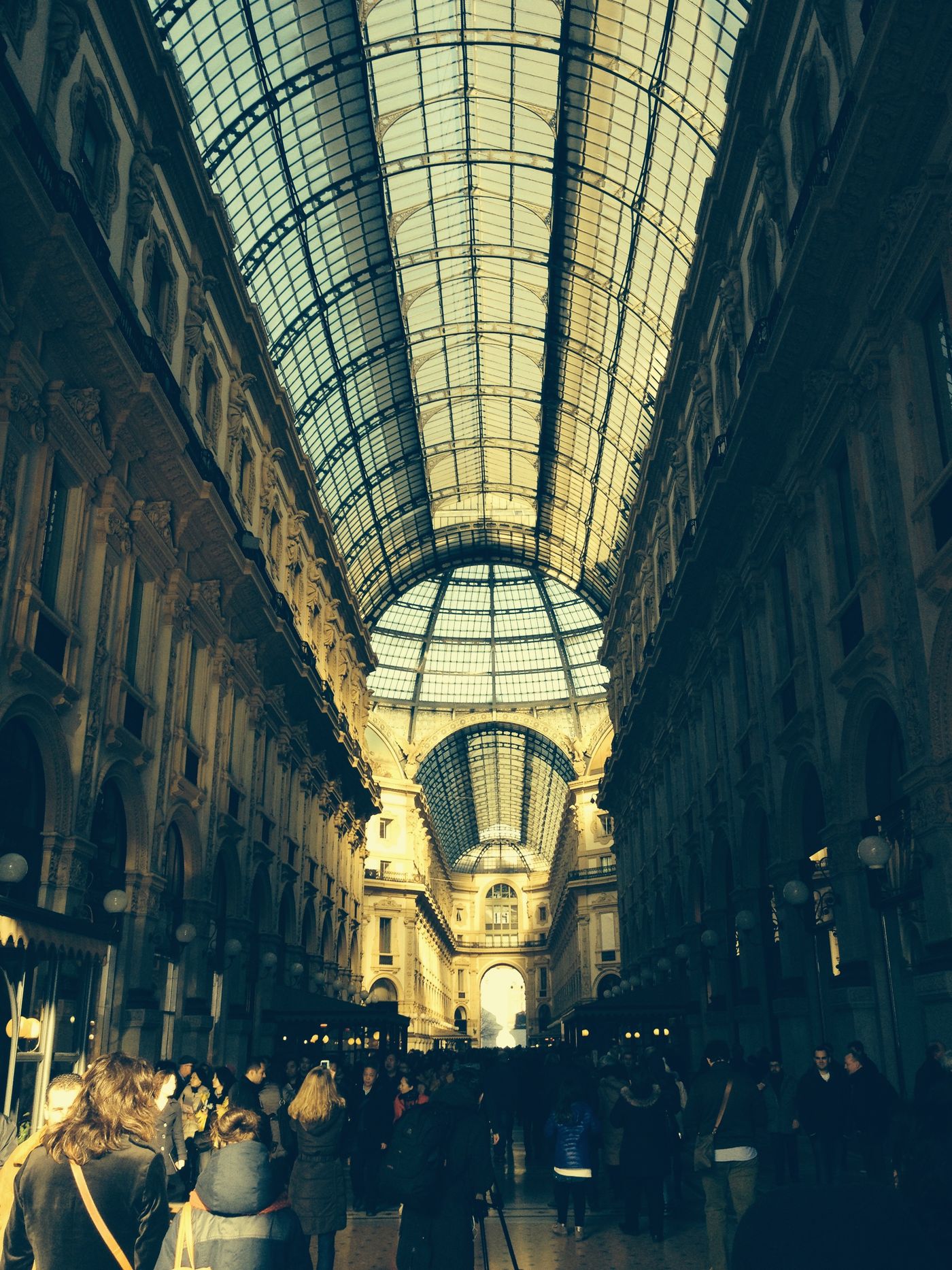
The Galleria is the 19th-century glass-roofed arcade connecting Piazza del Duomo to Piazza della Scala, and one of Milan's architectural icons in its own right. Inside sit several major flagships — the Prada store here traces the brand's origins as a 1913 leather-goods house, alongside Louis Vuitton, Versace and Tod's, plus the Camparino in Galleria, the historic 1915 bar central to the aperitivo tradition.
It sits technically just outside the Quadrilatero, one block south between the Duomo and La Scala, but it's universally treated as part of the same itinerary because it's five minutes from Via Montenapoleone. For a first Milan visit, it's essential as both a shopping stop and an architectural experience — the original Prada store is worth the visit even if you don't buy.
Where to base yourself
Bvlgari Hotel Milano
The most central of the Milan luxury hotels for Quadrilatero shopping, set in a private garden that's hard to believe exists in the centre. 58 rooms and suites, and a concierge with deep relationships across the surrounding houses. The right answer when the Quadrilatero is your whole plan.
Mandarin Oriental Milan
Equidistant from Montenapoleone and the Galleria, with the largest spa of any Milan luxury hotel and a strong contemporary-art programme, across four restored 18th-century palazzi. Concierge access to the flagships is excellent.
Four Seasons Milano
A restored 15th-century convent on Via Gesù, immediately east of Montenapoleone — arguably the most direct walking access of any hotel to the Quadrilatero, with a cloistered courtyard that feels separate from the city.
Park Hyatt Milano
Adjacent to the Galleria Vittorio Emanuele and five minutes from Montenapoleone, with the largest standard rooms of any central Milan hotel. Best for travellers weighting the Galleria and the Quadrilatero equally.
Armani Hotel Milano
The Armani brand hotel inside the Manzoni complex — the right answer for Armani loyalists wanting full immersion, and the only property giving direct access to the Armani/Privé spa and the upper floors of the complex.
The outlet villages: worth it?
Italy's outlet ecosystem is the most developed in Europe, with genuine 30–70% discounts on Italian brands. The trade-off is previous-season inventory and hit-or-miss sizing — worth a half to full day if you want depth at a discount and don't need the current collection.
Serravalle Designer Outlet
The largest designer outlet in Europe: over 300 brands including every major Italian house (Prada, Gucci, Bottega Veneta, Fendi, Versace, Tod's, Cucinelli) plus the major French and British names. Discounts on previous-season Italian leather goods are particularly strong. Plan a full day with a private driver.
Fox Town Mendrisio
Smaller than Serravalle, across the border in Switzerland, with a similar brand mix. Because it's outside the EU, crossing to reach it can trigger the Italian VAT-refund export step on your Italian purchases — a procedural wrinkle worth understanding before you drive. Efficient for anyone with a rental car and flexible time.
Pre-book a private driver to Serravalle or Fox Town through GetTransfer — both are far easier as a fixed-price return car run than by public transport with shopping bags.
The Italian VAT refund, step by step
Italy has the highest standard VAT of the major European shopping countries (22%, versus 20% in France and Germany), so the highest potential refund — but also the highest minimum spend and a slightly more bureaucratic process than France. The headline numbers:
| Item | Detail |
|---|---|
| VAT (IVA) rate | 22% on luxury goods |
| Effective refund | 11–15% of gross price after operator fees |
| Minimum spend | €154.95 in one store, same day (highest in Europe) |
| Export deadline | End of the third month after purchase |
| Eligibility | Non-EU residents, age 16+ |
| Operators | Global Blue, Planet; digital: Wevat, Zapptax |
- At purchase. Tell the sales associate before they ring up the sale and show your physical passport (photocopies aren't always accepted in Italy). The store generates a tax-free form; confirm your passport number, the purchase value and the store details are correct.
- At your final EU departure point. Find the Agenzia delle Dogane (Italian Customs) office at Malpensa, Linate or wherever you leave the EU, before checking bags. Italy uses digital validation kiosks and physical stamping depending on operator and airport. Goods must be unused, in your carry-on, and available for inspection.
- After validation. The operator processes the refund to your card within 2–8 weeks. Cash refunds at major airports are available but carry a higher service fee.
The €154.95 single-store minimum is genuinely restrictive — it's set at the threshold above which Italian VAT rules require an itemised invoice, and below it the operators don't bother. Spending €100–€150 across several smaller stores? The digital services (Wevat, Zapptax) can combine purchases across multiple Italian stores into one refund form, bypassing the per-store minimum. Spending well above €154.95 per store? The traditional Global Blue or Planet route is faster.
For the EU-wide framework and the US customs reality on the way home, see our Paris luxury shopping guide, which covers the refund process across the bloc in detail.
Milan vs Paris — and doing both
Milan is more concentrated and efficient; Paris is more spectacular and diverse. All of Milan's serious shopping happens in the four Quadrilatero streets, coverable in two relaxed days. Paris makes you walk over a kilometre between Avenue Montaigne, the Faubourg Saint-Honoré and Place Vendôme. For Italian brands, Milan has the deepest inventory and the most attentive flagship service; for French houses, Paris is the spiritual home and the inventory edge is real.
For travellers buying both, doing both cities in one trip is realistic. The direct Frecciarossa high-speed train runs Milan Centrale to Paris Gare de Lyon in about 6 hours 48 minutes at its fastest, with roughly four direct services a day — a scenic run through the Alps, though closer to seven hours in practice. One important 2026 note: the direct service is suspended from 11 September to 9 October 2026 for Mont Cénis tunnel works, with travel via Switzerland the alternative during that window. If time matters more than scenery, a 90-minute Linate–Charles de Gaulle flight, or a private-jet Linate–Le Bourget leg of about 1 hour 30 minutes block time, both beat the train.
Getting to Milan and around
Milan is served by Linate (LIN, the city airport, 7 km out), Malpensa (MXP, the main international airport, 50 km north-west) and Bergamo Orio al Serio (BGY, mostly low-cost, 50 km east). For any flight that operates there, Linate is the answer — the difference between a 15-minute and a 45-minute transfer to the centre.
Private aviation
Linate has full private-aviation FBO infrastructure and takes aircraft up to heavy-jet size. From London, charter to Linate runs roughly $9,000–$16,000 one-way on a midsize or super-midsize jet; from New York, roughly $90,000–$160,000 on a heavy or ultra-long-range jet. Malpensa takes any aircraft and suits ultra-long-range arrivals, at the cost of a 35–45 minute transfer to the centre.
Around Milan
The Quadrilatero is the most walkable luxury district anywhere — every flagship within 600 metres of the next, on pedestrian-friendly streets. The Montenapoleone metro station opens directly onto the district. For heavy purchases or a base further out, your concierge can have a private car wait at the boutiques; for serious shopping days, foot-and-private-car beats the metro.
Frequently asked questions
Where is the best luxury shopping in Milan?
The Quadrilatero della Moda — the Fashion Quadrilateral — bounded by Via Montenapoleone, Via della Spiga, Via Sant'Andrea and Via Manzoni in the historic centre of Milan. This is the most concentrated luxury shopping district in Europe and arguably the most walkable — you can cover every serious Italian fashion house, plus the major French and international brands, within a 90-minute walk. Via Montenapoleone is the most prestigious street and holds the highest concentration of flagship stores, including Prada, Gucci, Versace and Bulgari. Via della Spiga is the parallel street with the more boutique-feeling smaller flagships. Via Sant'Andrea connects the two and houses the Hermès and Chanel flagships. Via Manzoni is the northern boundary street with the more contemporary brands and the Armani complex.
How does the Italian VAT refund work for non-EU tourists in 2026?
Italy's standard VAT (IVA) rate is 22% — the highest of the major shopping countries in Europe — and the actual refund after fees is 11 to 15% of the purchase price. The minimum spend is €154.95 in a single store on the same day, the highest minimum in Europe, set at the threshold above which Italian VAT rules require an itemised invoice. The export deadline is the end of the third month after purchase. Goods must be unused and validated by Italian Customs (Agenzia delle Dogane) at the customs office of your final EU departure point — Milan Malpensa, Milan Linate or wherever you exit the EU. Italy uses both traditional paper forms (Global Blue, Planet) and digital validation depending on the operator, and digital-only services such as Wevat and Zapptax can combine purchases across multiple stores to bypass the per-store minimum.
Is Milan or Paris better for luxury shopping?
Milan is more concentrated and more efficient, Paris is more spectacular and more diverse. The entire serious shopping in Milan happens in the four streets of the Quadrilatero, coverable in two days at a relaxed pace. Paris requires walking between Avenue Montaigne, Faubourg Saint-Honoré and Place Vendôme, which are over a kilometre apart. For Italian brands (Prada, Gucci, Versace, Dolce & Gabbana, Bottega Veneta, Fendi, Brunello Cucinelli, Loro Piana, Bulgari, Tod's, Valentino) Milan has the deepest inventory and the most attentive flagship service. For French brands (Hermès, Chanel, Dior, Louis Vuitton, Saint Laurent) Paris is the spiritual home and the inventory advantage is real. For travellers buying both, doing both cities in one trip is realistic: the direct Frecciarossa high-speed train runs Milan to Paris in about 6 hours 48 minutes, though a 90-minute flight or private jet is faster if time matters more than scenery.
Should I shop at the Italian outlet villages instead of central Milan?
For genuine bargain hunting on Italian brands, yes — the Serravalle Designer Outlet (about 90 minutes south of Milan) and Fox Town Mendrisio (about 50 minutes north, across the border in Switzerland) both offer 30 to 70 percent discounts on Italian luxury brands. The trade-off is that inventory is previous-season, sizes can be hit-or-miss, and the experience is fundamentally different from a flagship boutique visit. For a specific current-season signature item (a new Bottega bag, a current Prada wallet) the central Milan flagships are the right answer. For depth of inventory at a discount where the latest collection is not essential, the outlets work well — plan a half to full day each and combine with a private driver.
How much can a US citizen bring back from Milan before paying duty?
The US returning-resident personal exemption is $800 per person, refreshed every 31 days, with a flat 3% duty on the next $1,000 (from $800 to $1,800) and standard tariff rates above that. A family of four can pool exemptions for $3,200 duty-free combined. The Italian VAT refund you collect at your EU exit reduces the price you actually paid, so declare the post-refund price at US Customs, not the original gross price. For high-value purchases of €10,000 and above, declaring honestly is materially less expensive than the penalties for being caught under-declaring.
What is the dress code at the Milan luxury houses?
Smart casual is the minimum, business casual the ideal. The Milan flagships are arguably even more clothing-conscious than the Paris equivalents, because Italian luxury culture takes personal presentation more seriously than almost anywhere else. Boutique staff in the Quadrilatero read clients on how they are dressed and treat well-presented shoppers differently from casual tourist traffic. For private appointments at Prada, Gucci, Bottega Veneta and the major Italian houses, request through your hotel concierge in advance — the Bvlgari Hotel, Mandarin Oriental, Four Seasons and Park Hyatt all hold direct relationships with flagship managers and can secure appointments unavailable to walk-ins.
How many days do I need to shop Milan properly?
Two focused days covers the Quadrilatero della Moda and the Galleria Vittorio Emanuele at a relaxed pace, including private appointments at two or three houses. A third day lets you add an outlet village (Serravalle or Fox Town) or a cultural pairing such as the Last Supper and the Duomo. One day is enough only if you arrive with a precise target list and pre-booked appointments; the district rewards unhurried browsing, and the best flagship service happens when you are not visibly rushing between stores.
Make Milan a complete trip
Pair the right hotel with concierge appointments at the major houses and a private car for the outlet day. JetLuxe handles the charter into Linate; the grand hotels handle the appointments.
Price a private jet on JetLuxe →Prices, VAT thresholds, refund percentages and rail timings are typical of Milan as of July 2026 and change — the VAT-refund rules, operator fees and the Frecciarossa engineering-works schedule in particular should be verified directly before you travel. This guide contains affiliate links to travel services; bookings made through them may earn us a commission at no additional cost to you.